
At some point in most flooring decisions, it comes down to two timbers. Oak or walnut. Both are hardwoods. Both are available in solid and engineered formats. Both look extraordinary when properly installed and finished. And yet they're genuinely different floors — different in colour, different in character, different in how they age, different in what they cost, and different in what they ask of the homeowner who lives with them.
This article isn't going to tell you that one is better. It's going to tell you exactly what each one is, what it does, and what it looks like in a real home — so you can make the call yourself with the right information rather than someone else's preference.
The Visual Difference: What Each Timber Actually Looks Like
This is where most people start — and it's the right place to start, because the visual character of a floor affects everything about a room.
-
Oak
Oak has a warm, golden-to-light-brown tone with a coarse, open grain that gives it visible texture and movement. The grain markings in oak are pronounced — the medullary rays (the flecks that run perpendicular to the grain) are one of the most distinctive features of the species, particularly in quarter-sawn boards where they appear as silver or golden streaks across the face. Oak is not a quiet floor. It has presence, grain interest, and a warmth that reads across the room.
As oak ages, it deepens in colour — the light golden tone of a freshly finished floor gradually transitions toward a richer amber-brown over years of exposure to light and air. This change is a characteristic people either love or find inconvenient depending on how they've positioned the floor within the overall design of the space.
-
Walnut
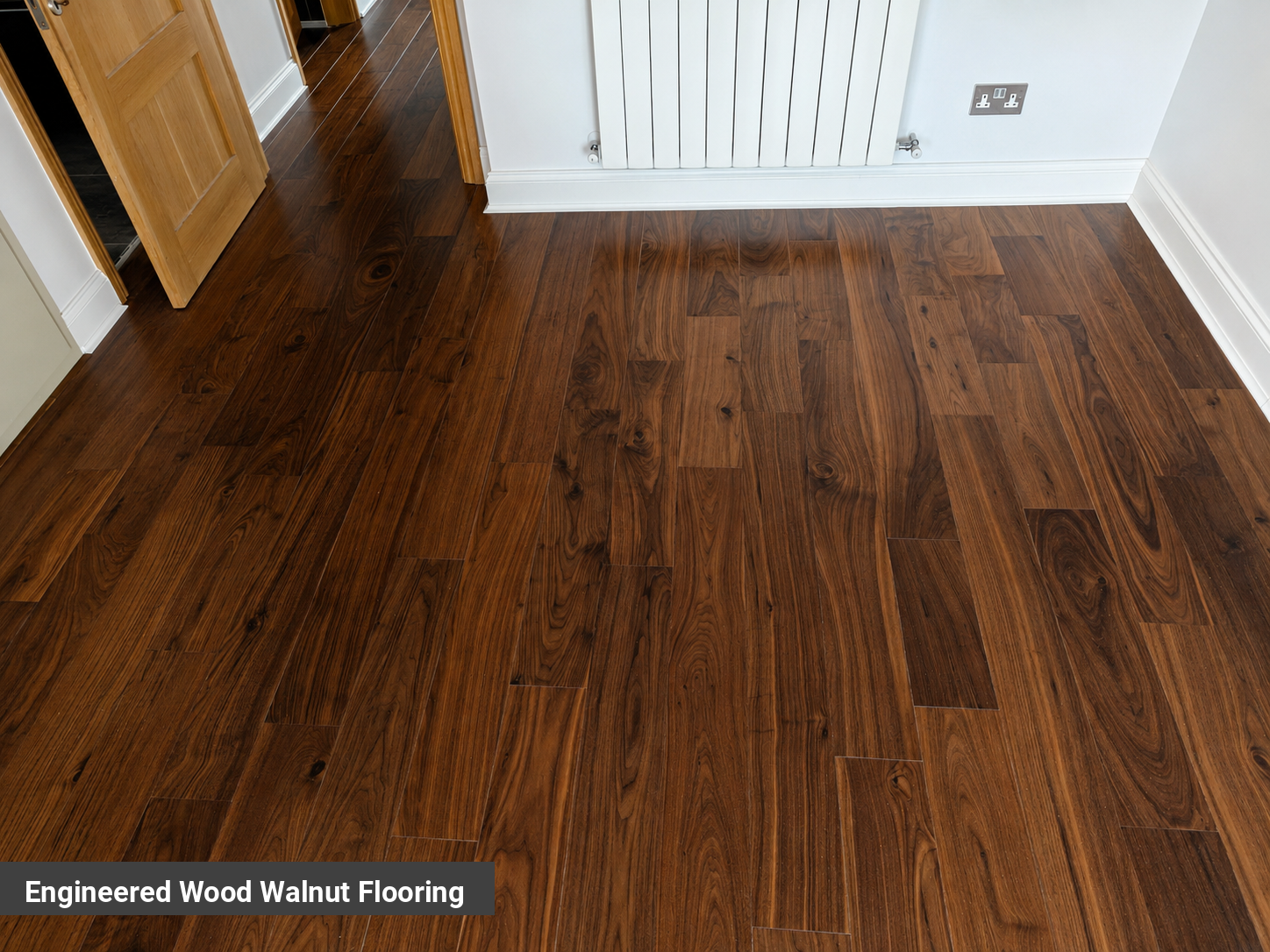
Walnut is a fundamentally different visual experience. It's dark — a rich, chocolate-brown to deep coffee tone with purplish or grey undertones that give it a depth and sophistication that lighter timbers simply can't replicate. The grain of walnut is generally straighter than oak, with less of the coarse texture and more of a smooth, fine quality that contributes to its reputation as a luxury material. Occasional wave patterns and figure in the grain add visual interest without the structural heaviness of oak's pronounced markings.
Walnut does something unusual over time: it lightens rather than deepens. New walnut is at its darkest. Over years of light exposure, it transitions toward a warmer, medium-brown tone. The floor gets lighter as it ages, which is the opposite of oak's behaviour and something worth knowing if you're building a room scheme around a specific walnut tone.
The visual choice, in most cases, is about light. Walnut absorbs it. Oak reflects it. In a dark room with limited natural light, oak opens the space. In a room with good light where the floor is meant to anchor and ground the design rather than brighten it, walnut earns its place.
Hardness and Durability: Which Floor Takes More Punishment?
Both oak and walnut are hardwoods, but they're not equally hard — and the difference matters in a busy home.
Hardness in timber is measured on the Janka scale — a standardised test that measures the force required to embed a steel ball halfway into the surface of the wood. The higher the number, the harder the timber.
European oak sits at approximately 1120 lbf on the Janka scale. American black walnut sits at approximately 1010 lbf. Both are genuine hardwoods that will outlast softwoods like pine significantly — but oak is meaningfully harder than walnut, and that difference shows in how each floor handles the daily wear of a busy household.
In practical terms: oak scratches less readily than walnut. In a home with dogs, children, or heavy foot traffic — particularly in hallways, kitchens, and open-plan living areas — this distinction becomes visible over time. An oak floor under the same conditions as a walnut floor will show less surface wear after five years, and will require restoration less frequently.
This doesn't make walnut a poor choice — far from it. But it does make the room's function relevant to the decision. For a bedroom or a study where traffic is light and foot contact is soft-soled, the hardness difference between oak and walnut is largely irrelevant. For an entrance hall that takes outdoor shoes daily, or a kitchen where chair legs drag across the floor repeatedly, oak's additional hardness is a practical advantage.
How Each Timber Takes Stain and Finish
One of the things that makes oak so versatile is how it takes stain. The open, coarse grain of oak absorbs colour readily and consistently — which is why oak floors can be taken from pale whitewash to deep ebony and produce a consistent result across the whole floor. Our wood floor staining service is most often specified on oak for exactly this reason.
We carried out a project in Wandsworth where engineered oak flooring was sanded back to bare wood and finished with a Morrells walnut stain from their lightfast range — sealed with a coat of primer and two coats of Bona Mega water-based lacquer in matt sheen. The oak took the walnut stain beautifully, producing a floor that had the depth and character of natural walnut at the cost and structural properties of oak. This is one of the reasons oak is so popular — it can become almost any colour while retaining the structural qualities of a high-performance hardwood.
Walnut and staining have a more complex relationship. Walnut's natural colour is already so rich and distinctive that staining it to a different tone is rarely the point — most people who choose walnut do so specifically for its natural appearance. The more relevant consideration with walnut is the finish type, because walnut requires a specific primer to be applied after sanding and before sealing to preserve its natural dark brown colour. Without this step, the colour of walnut can shift slightly under certain lacquer formulations — something that's easy to manage with the right product knowledge but that a less experienced contractor might overlook.
We installed a Timberlay Engineered Walnut Wood Flooring, Lacquered, 190x20mm project in West Kensington — 13 square metres of floating installation over original floorboards onto Duralay Excel Silver underlay with DPM barrier. The lacquered finish on that walnut product gives it the durability of a sealed surface with the colour preservation that walnut needs — and the lacquer is non-yellowing, water-based, low-VOC, and available in extra-matt, matt, satin, and gloss sheens.
Solid vs Engineered: Which Format Suits Each Species?
Both oak and walnut are available in solid and engineered formats — and the decision between the two formats follows the same logic regardless of species.
- Solid oak and solid walnut are the same species all the way through the board. They're the most restorable format — solid timber can be sanded and refinished multiple times over a lifetime — but they're also the most moisture-sensitive and should not be installed over underfloor heating. As our solid hardwood floors installation service explains, solid wood tends to block a significant amount of heat that underfloor heating emits, making it less efficient and creating thermal stress in the boards.
- Engineered oak and engineered walnut have the same real hardwood surface layer as solid — what you see and walk on is the same species — but the plywood core beneath it resists moisture movement and makes the floor compatible with underfloor heating. Engineered is the right specification for kitchens, ground floor rooms, and any space where humidity or temperature fluctuation is a factor. Our engineered floor installation service covers both species across a wide range of plank widths and finish options.
One practical note on engineered walnut specifically: because walnut is a premium species, the cost difference between solid and engineered walnut is less pronounced than with oak. Engineered walnut uses less of the slow-growing, expensive walnut timber in the surface layer — which makes it more cost-effective without compromising on the appearance. This makes engineered walnut a particularly compelling specification for larger areas where the total material cost of solid walnut becomes significant.
Herringbone and Parquet: Which Species Works Better?
Both oak and walnut are available in parquet block and herringbone formats — and both look extraordinary when the pattern is right for the space. But they look different in that format, and the difference is worth considering.
- Oak herringbone is the classic combination — the warm golden tones of oak in the herringbone pattern has a timeless, architectural quality that works in period and contemporary settings equally. The grain of oak in herringbone blocks catches the light from multiple angles simultaneously because adjacent blocks run in different directions — the result is a floor with genuine visual depth and warmth that changes character throughout the day as the light moves.
- Walnut herringbone is a more dramatic choice. The dark richness of walnut in a herringbone pattern is genuinely striking — it has a formality and depth that oak herringbone doesn't quite replicate. In a high-ceiling room with good natural light, walnut herringbone is one of the most impressive floor finishes possible. In a smaller room or one with limited light, the depth of the walnut tone can make the space feel enclosed rather than dramatic.
We carried out a project in Wimbledon restoring a mix of walnut and oak engineered wood flooring in the same property — the client had both species as part of an existing floor installation that had become tired overall. The combination of the two species in adjoining spaces, rather than the same species throughout, is something we encounter regularly and works effectively when the transition between rooms is handled well.
Cost: The Honest Comparison
This is the practical reality that often shapes the decision, and it deserves a straight answer.
Oak is less expensive than walnut — both as a raw material and as a finished floor product. The price difference between oak and walnut flooring in comparable specifications (same board width, same thickness, same finish type) is typically meaningful — walnut commands a premium that reflects the slower growth rate of the species, its relative scarcity compared to oak, and the higher cost of processing a dense, premium hardwood.
In engineered format, the price difference narrows somewhat because less of the expensive walnut is used in the surface layer. But walnut remains consistently more expensive than oak across most product ranges and specifications.
For a homeowner choosing between the two species on a budget, oak is the more practical choice — and it's worth noting that oak stained to a walnut colour (as in the Wandsworth project referenced above) produces a floor that has the visual depth of walnut at the material cost of oak. This is a legitimate option that we're happy to discuss at a site survey for clients who want the walnut aesthetic without the walnut material cost.
Which Rooms Suit Which Species?
- Oak works best in: Open-plan living spaces where the floor needs to be present but not dominant. Rooms with limited natural light where the warmer, lighter tone of oak opens the space. Hallways and high-traffic areas where the additional hardness of oak gives it a practical advantage. Period properties where the warmth and character of oak grain suits the architectural context.
- Walnut works best in: Rooms with good natural light where the darker tone creates drama rather than enclosure. Dining rooms and formal living rooms where the floor is part of a considered, sophisticated interior scheme. Bedrooms where light traffic means hardness is less critical and the luxurious quality of the dark timber creates a different ambience. Contemporary interiors where walnut's straight grain and depth complement clean lines and neutral palettes.
- Both work equally well in: Any room where the species choice is driven primarily by the colour palette of the space rather than functional requirements. Both species restore well, both take professional lacquer and oil finishes to a high standard, and both last for decades when properly maintained.
Maintenance: What Each Species Needs
The maintenance requirements of oak and walnut are shaped more by the finish applied than by the species itself — a lacquered oak floor and a lacquered walnut floor have essentially the same maintenance routine. The species-specific considerations are relatively minor but worth knowing.
- Oak is susceptible to the iron-tannin reaction — the dark black staining that appears around metal fixings, near taps and sinks, and anywhere iron in water contacts the tannin-rich timber. This is addressable through professional restoration, and it's one of the most common reasons oak floors and oak worktops come to us for restoration work. It's not a reason to avoid oak — just a reason to keep water from sitting near metal contact points and to act promptly if dark staining begins to appear.
- Walnut requires the specific primer mentioned earlier to preserve its natural colour under lacquer. Beyond that, a lacquered walnut floor is straightforward to maintain — pH-neutral cleaner, prompt spill management, felt pads under furniture. The darker colour of walnut does a better job of concealing fine scratches and dust than lighter species, which means it can look presentable for longer between professional maintenance events.
For detailed guidance on maintaining lacquered and oiled wood floors, see our article on how air humidity and damp can affect your wooden floors — the principles that protect floors from moisture damage apply equally to both species.
Contact Floorworks™ for Professional Flooring Solutions
Summary
Oak and walnut are genuinely different floors that suit different spaces, different budgets, and different design intentions. Oak is harder, more affordable, more versatile in colour through staining, and better suited to high-traffic areas and rooms where a lighter, warmer tone is the priority. Walnut is richer, more premium in both appearance and cost, better suited to lower-traffic rooms and spaces where the dark, luxurious character of the timber is precisely what the interior needs.
There's no wrong answer — only the answer that's right for your specific room, your specific lifestyle, and your specific budget. At Floorworks, we work with both species regularly — from new engineered floor installation in both oak and walnut through to restoration of existing floors where the species has been in place for years.
Book a free site visit and we'll look at the space, discuss both options, and give you an honest recommendation based on what we actually see rather than a preference for one species over the other.


