
Stand in an empty sports hall before the lines go down and it's just a floor — a big, blank, slightly intimidating rectangle. Add the lines, and suddenly it's a basketball court. And a badminton court. And a five-a-side pitch. And a netball court, all layered on top of each other in different colours, somehow readable at a glance by a room full of ten-year-olds mid-PE lesson. That's the quiet trick of line marking — it's one of the least glamorous parts of a sports floor project, and one of the most functionally important.
If you're planning a new floor, refurbishing an old one, or just trying to work out why your hall's markings look faded and confusing, here's what's actually involved.
What Line Marking Actually Is?
Line marking is the process of painting the court boundaries, zones, and playing lines onto a sports floor — badminton courts, basketball courts, netball, five-a-side football, volleyball, whatever the hall needs to host. It sounds simple until you consider that most school and leisure centre halls aren't marked for one sport. They're marked for four, five, sometimes more, all sharing the same patch of floor.
That's why a well-marked hall relies so heavily on colour coding. Each sport gets its own colour — commonly blue for badminton, red for basketball, yellow for netball, and so on — so that a PE teacher, a referee, or a kid chasing a ball can tell at a glance which lines apply to which game, without the whole floor turning into visual noise. Getting that layout right, so the lines don't clash, cross awkwardly, or crowd around fixed equipment like basketball hoops and wall-mounted sockets, is a proper bit of planning before a single line gets painted.
Colours and Courts: What Each Sport Actually Uses
This is the bit most people never think about until they're standing in a multi-sport hall trying to work out which lines belong to which game — and it's worth understanding, because the colours aren't arbitrary. They're chosen for contrast against the floor and against each other, so that several overlapping court layouts can coexist on one surface without becoming unreadable. Line width matters just as much as colour, since it's set by each sport's own governing body rather than being a matter of house style.
Here's how it typically breaks down in a UK sports hall:
- Badminton: White, occasionally yellow — standard 40mm width
- Basketball: Black or dark blue, sometimes white on darker synthetic surfaces — standard 50mm width
- Netball: Red
- Volleyball: Light green or light blue
- Handball: Orange
- 5-a-side football / futsal: Yellow or dark blue
- Tennis / pickleball: Yellow or white
A few things become obvious once you see the list laid out like this. First, the palette is deliberately spread across the colour wheel — reds, blues, greens, oranges, yellows — precisely so that no two sports sharing a hall end up with easily confused lines. Second, width isn't incidental: a badminton court's 40mm lines and a basketball court's 50mm lines are different enough to tell apart by eye even before you register the colour, which matters in a fast-moving PE lesson where nobody has time to double-check a rulebook. And third, the "occasionally" and "sometimes" caveats above aren't vague hedging — they reflect genuine, sensible adjustments made for the floor itself. White basketball lines on a very light timber or vinyl floor simply won't show up well, so a hall with a pale surface will often switch to black or dark blue instead, and the correct choice is exactly the kind of detail worth confirming with your installer before any paint goes down, not after.
The Rules Aren't Optional
This isn't a "roughly measure it out and go" job. Competitive and school sport in the UK follows Sport England and National Governing Body guidelines, and they're specific — line widths, court dimensions, and positioning all have defined tolerances. Get it meaningfully wrong, and a hall can find itself unable to host certain fixtures or tournaments, which is a frustrating discovery to make after the paint has already dried.
For a school hall specifically, this matters even when nobody's chasing a national qualifier — because inconsistent or incorrectly sized lines are confusing for pupils and staff long before they're a compliance issue. A badminton court that's a few centimetres out doesn't ruin anyone's afternoon. Lines that don't match up with the actual court dimensions pupils are being taught, though, quietly undermine the PE lesson itself.
The Floor Underneath Changes Everything
Here's the part that surprises people who haven't been through this before: line marking isn't a single, universal process. What you can do — and what paint you use — depends entirely on what the floor is made of.
- Timber floors, including Junckers and other engineered sports timber, need a marking paint that's compatible with the finish underneath it — this isn't a case of reaching for whatever tin of paint is nearest. At Floorworks, we use specialist sports line marking paint from Bona and Junckers, the same manufacturers behind the floor finishes themselves, specifically because these paints are formulated to bond properly with a sports timber floor and to accept a lacquer coat over the top without lifting, bleeding, or discolouring. And that sequencing matters: the line paint always goes down before the final lacquer coat, never after. The lines are painted first, left to dry and cure properly, and only then is the final protective coat applied over the entire floor — lines included. That final coat is what locks the lines in place and stops them wearing away under thousands of trainers a week; skip it, or rush it, and painted lines on a timber floor have a genuinely short life.This sequence is also why line marking needs proper time built into the schedule, not squeezed in as an afterthought. Allowing extra time for the paint to cure fully before lacquering isn't optional — on a timber sports floor, this stage alone can take over two days, and trying to rush it risks exactly the lifting and bleeding problems a hurried job produces. If your hall runs one of these floors, our piece on when Junckers flooring is the irreplaceable solution is worth a read alongside this one, since the two go hand in hand — the right timber, finished and marked properly, is what makes a hall genuinely durable.
- Vinyl and PU floors behave differently again. Lines can sometimes be over-painted or carefully removed and reapplied, but it depends heavily on the age and type of the existing paint, so it's very much a case-by-case judgement rather than a fixed rule.
Sports hall finishes, more broadly — the sealant or lacquer that protects the entire floor surface, lines included — are what determine how long any of this actually lasts day to day. We've written more on the specifics of the best floor finishes for school sports halls, which is the natural companion piece to this one if you're weighing up the full spec, not just the lines on top of it.
When Line Marking Happens
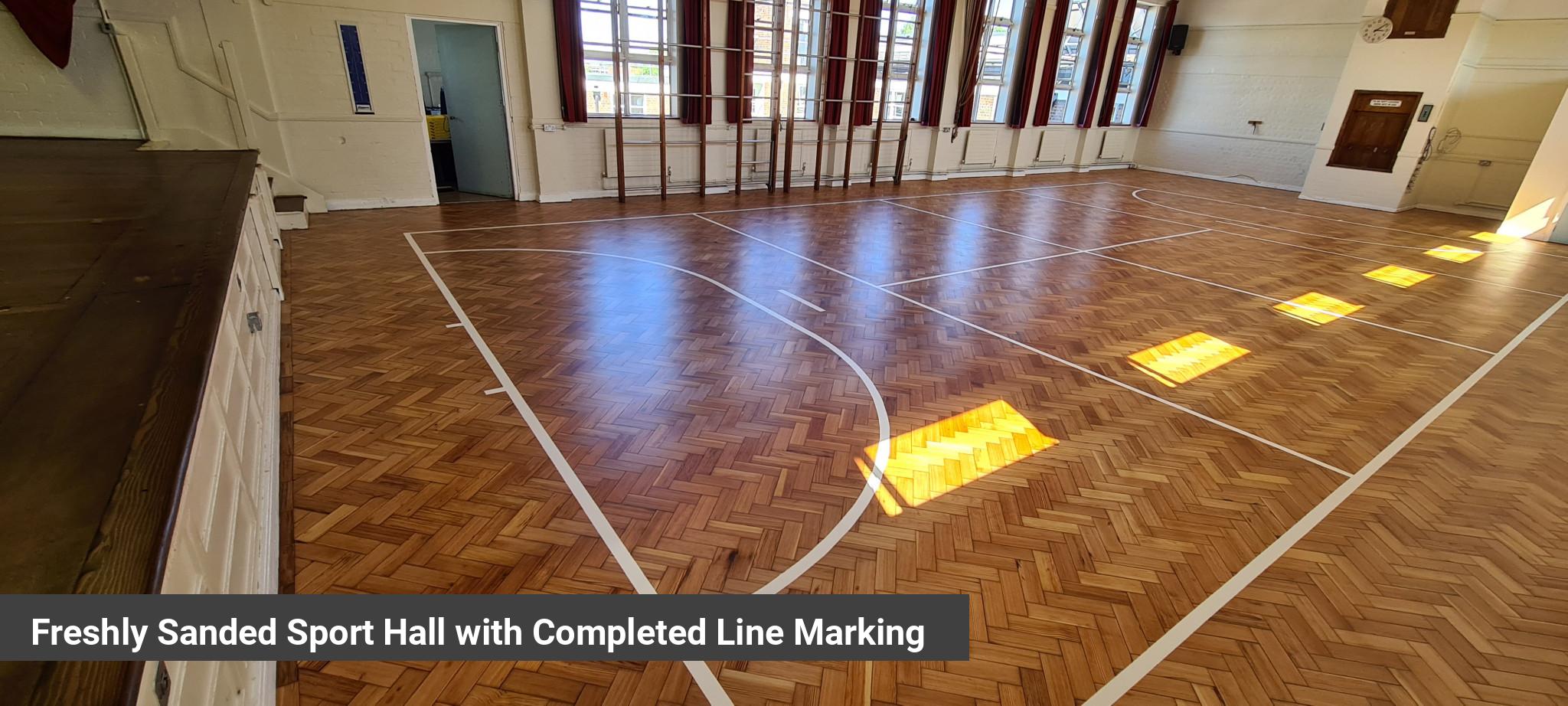
Line marking almost always comes near the end of a floor restoration project, not the start or after its completion. On a new or newly sanded and resealed floor, the lines go down once the primer has cured properly — and then, depending on the floor type, a further protective coat may go over the top of the lines themselves. Rushing this sequence is a common source of complaints later: lines applied too early, or sealed too soon, tend to bleed, lift, or wear unevenly.
On timber floors, once the primer is applied, the line marking will begin. It may involve one or more colours, respectively for one or more sport games.
For schools, timing is as much about the calendar as it is about the floor. Nobody wants a hall out of action during term time, so this kind of work is almost always scheduled for holidays, weekends, or other closure periods — which is exactly the same disruption-minded approach we take across our flooring services for schools, where planning around the academic calendar isn't an afterthought, it's built into how the job is scheduled from day one.
Contact Floorworks™ Today for a Free Professional Consultation

To give a sense of scale: a full restoration of a school sports hall floor — sanding back the existing surface, applying line marking paint, allowing it to cure, and then applying the final protective coats — can realistically take around a week from start to finish, depenfing on the size of the area.
That's not wasted time; every stage in that week is doing something specific, and trying to compress it usually means sacrificing one of the stages that makes the finished floor actually last. Each colour is applied in a separate stage.
It's also exactly why booking this kind of work in well ahead of a school holiday, rather than at the last minute, makes the difference between a job that fits comfortably into the closure period and one that runs into the first day of term. If you're weighing up a wider restoration project alongside re-marking, our guide on how to prepare for wooden school floor restoration covers what a school needs to think about before the work starts.
How Long Do Lines Actually Last?
This is the question we get asked most, and the honest answer is: it depends on usage, cleaning, and floor type — but as a general rule, lines in a busy school or leisure centre hall need refreshing somewhere in the region of every five to ten years. Heavy foot traffic gradually wears paint down, especially along the most-used lines — the edges of a basketball key see far more scuffing than a rarely-used badminton service line, for instance, and it shows.
A few signs it's worth getting a professional opinion:
- Lines that have visibly faded or become patchy in high-traffic zones
- Colours that are hard to tell apart at a glance, especially under hall lighting
- A floor that's due for a screen-and-recoat or full sand and reseal anyway — since lines will need reapplying as part of that process regardless
- A hall that's being reconfigured for a new sport or an additional court layout
Getting It Right the First Time
Line marking sits at an odd intersection — it's cosmetic in the sense that it's paint on a floor, but it's functional in a way that genuinely affects how a space is used every single day. A hall with confusing, mismatched, or worn-out lines doesn't just look tired — it makes PE lessons and matches harder to run properly.
If you're planning new flooring for a school hall, refreshing markings on an existing floor, or simply not sure what condition your current lines and finish are in, we're happy to take a look. Get in touch via Floorworks for an honest assessment of what your hall actually needs — whether that's a full sand, seal and re-mark, or simply a professional refresh of the lines you've already got.
Get in touch via Floorworks for a Professional Assessment


