
Walk into most school buildings and the floor tells you everything about how well the place has been looked after. A sports hall where the lacquer has worn through to bare timber in the key zones. A Victorian corridor where parquet blocks are beginning to lift at the edges. A classroom where decades of scuffing have turned what was once a warm oak floor into something grey and indistinct.
We see these floors regularly, and the same thing is almost always true: the problem didn't happen overnight, and a timely intervention would have been a fraction of the cost of what's now needed. If you're unsure where your floors stand, our school floor sanding service begins with a free, no-obligation site visit to assess the wood type, existing damage and wear patterns. This guide is about understanding what school floors actually need — not just to look presentable, but to perform safely and last.
First, Understand What You're Actually Working With
A sports hall floor and a Victorian parquet corridor are completely different surfaces with completely different needs. Treating them the same way is one of the most common mistakes we see — and it's usually expensive to undo.
-
Sports halls
Sports halls in modern buildings are almost always maple or beech hardwood on a sprung substructure — a system engineered to absorb athletic impact and protect joints. The floor needs to be resilient enough for court sports but the finish on top needs to cope with something far broader: basketball boots, gymnastics, hall exams, assemblies, parent evenings, community events. It's one of the most demanding surfaces in any building, and it needs to be treated as such.
-
Old school buildings
Old school buildings tend to have parquet — oak, pine, or occasionally beech, laid in herringbone or block patterns. These floors were built to last centuries, and many of them have. But they accumulate decades of old finish, grime, and uneven wear, and individual blocks loosen over time as the adhesive beneath them ages. This isn't a surface you can maintain with an occasional polish. It needs proper parquet floor sanding and restoration to perform as it should.
-
More recently built schools
More recently built schools often have engineered hardwood — a real hardwood surface layer bonded to a stable core. These floors look and feel like solid timber but have one important limitation: the surface layer is thin, and it can only be sanded a finite number of times. Over-sanding it is irreversible. If you're not sure what you have, find out before any sanding work begins.
Before Any Finish: Sort the Floor Itself
There's a version of school floor renovation that skips straight to the finish and hopes for the best. It never ends well. The finish is only as good as what's underneath it, and if the floor has structural problems — loose parquet blocks, lifted boards, damaged sections — applying lacquer over the top of them just buries the problem until it forces its way back up.
For parquet floor restoration, that means re-securing loose or lifted blocks before anything else, replacing sections that are beyond saving, and addressing any subfloor movement that has caused unevenness across the surface. In older school buildings, this is rarely a minor job — but it's the job that makes the rest of the work worthwhile.
For floorboards, it means checking for boards that have worked loose over decades of use, replacing any that are damaged beyond repair, and dealing with gaps between planks that have opened through natural movement. Gap filling at this stage — using a flexible filler matched to the timber — stabilises the surface and prevents moisture from working beneath the finish later.
For sports halls, structural assessment means something slightly different. The sprung substructure beneath the boards needs to be checked for damage, particularly in the areas that take the heaviest use — under basketball hoops, around the centre circle, at the edges near walls where moisture can collect. A sports hall floor with a compromised substructure will flex unevenly, and no finish will mask that. It needs to be addressed at the source.
Sanding: The Stage That Everything Else Depends On
Once the structural work is done, the floor needs to come back to bare timber. This is the stage that determines the quality of everything that follows.
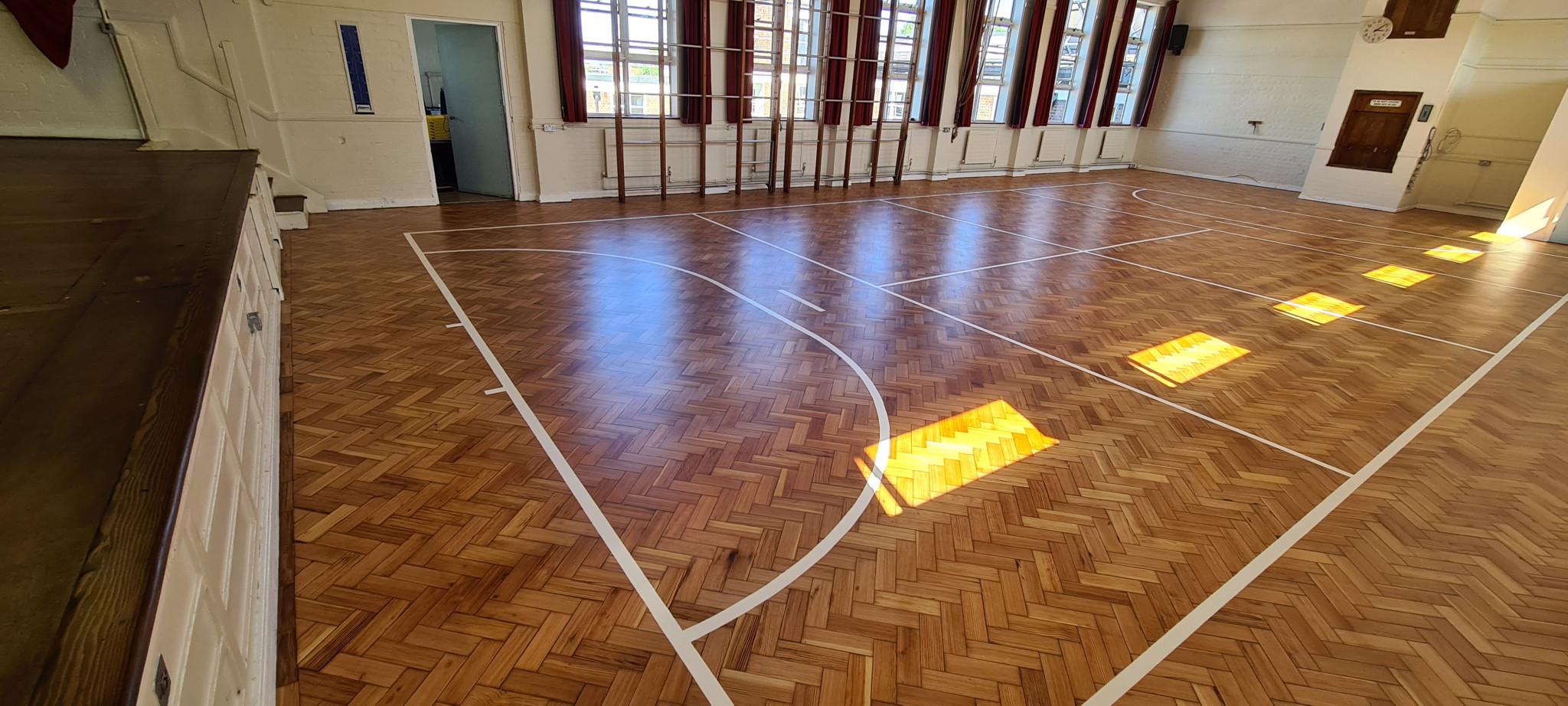
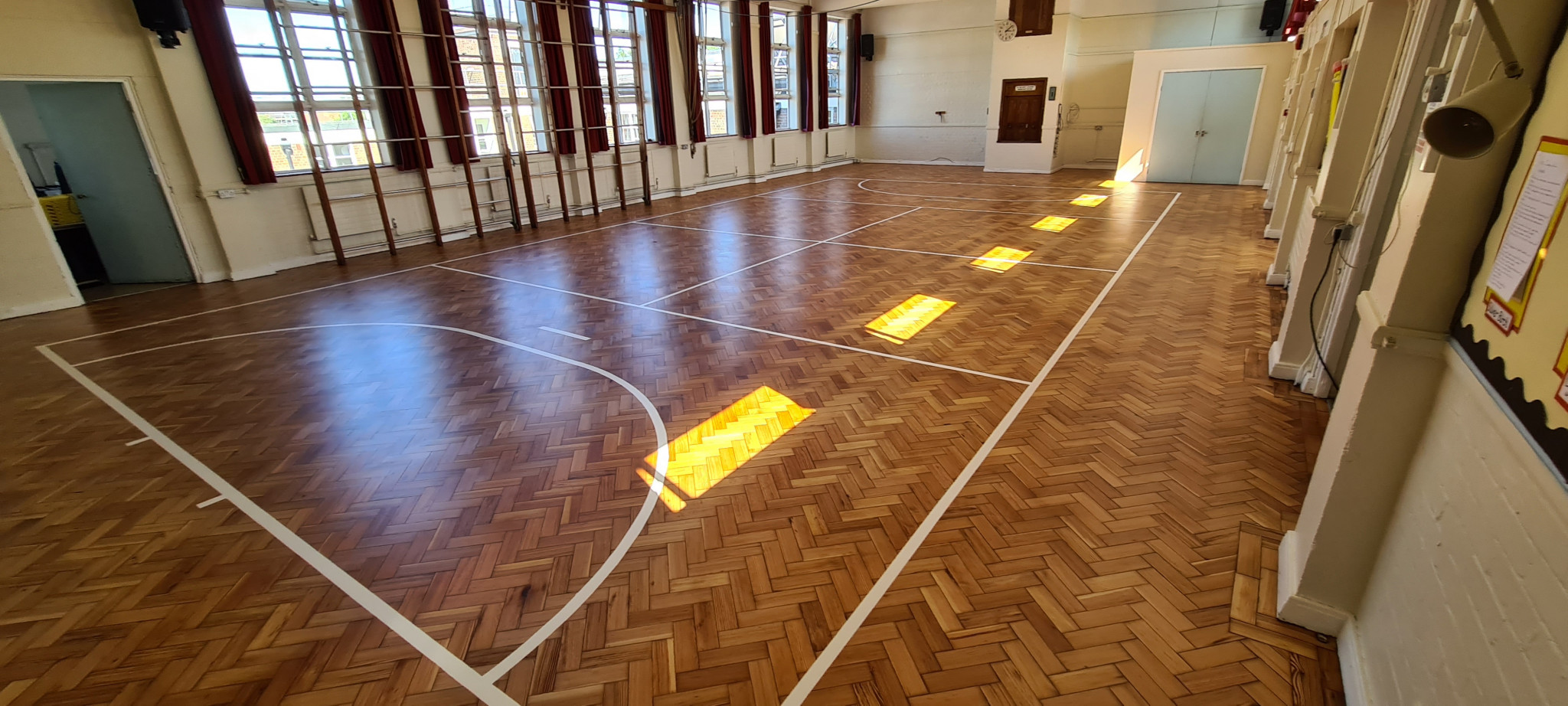
For parquet, sanding is a genuinely skilled discipline. Parquet has short and long grain running in multiple directions depending on the pattern, and the sanding direction and technique have to account for that. Sand it wrong and you'll see the scratches clearly through any clear finish. Sand it right and you reveal the natural warmth and character of the timber — the kind of result that makes people stop and look at a floor they'd walked past for years without noticing.
For sports halls, the challenge is consistency across a large area. Heavy-duty commercial drum sanders and edging machines need to be operated by someone who knows how to keep the passes even. Any inconsistency in the surface — any area that's slightly lower or higher than the rest — shows immediately under raking light and creates an uneven playing surface. In a sports environment, that's not just cosmetic. It matters for safety.
In both cases, dust extraction is running throughout. Modern professional systems capture the bulk of airborne particles at source, which keeps the building clean, protects the freshly sanded surface from contamination, and means the space can be reoccupied far sooner.
Choosing the Right Finish: This Is Where Most Decisions Go Wrong
The finish is what most people focus on, and it's where most of the questions come from. The answer for schools and sports halls is almost always the same: 2K water-based polyurethane. Here's why, and what the alternatives are actually good for.
There are dozens of floor lacquers on the market. Most of them are fine. A handful of them are genuinely exceptional. Over years of working on school floors, sports halls, and high-traffic commercial spaces, we've landed on five products that we reach for consistently — not because they're the most expensive, or the most heavily marketed, but because they perform when it matters and they don't let us down.
Here's what each one does, and why it earns its place on our van.
-
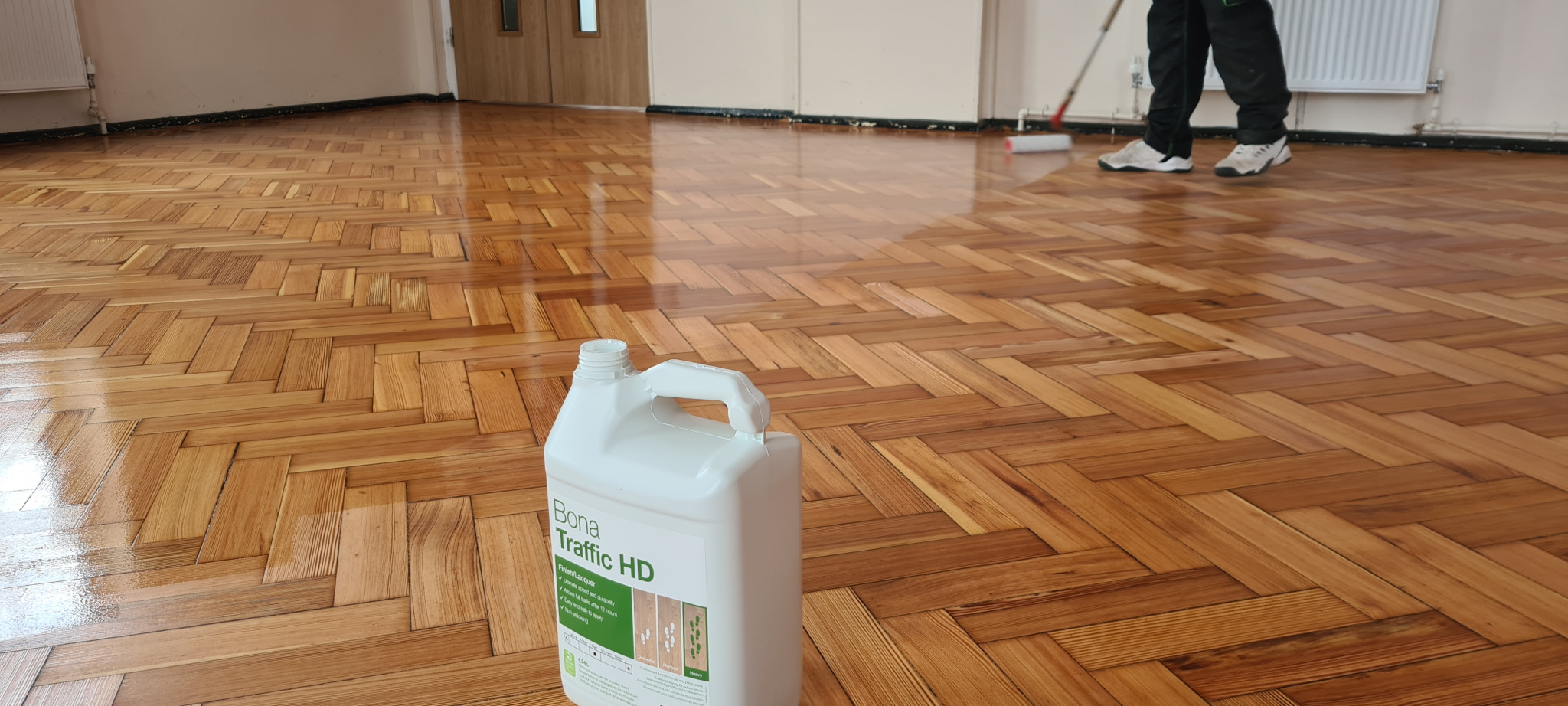
Bona Traffic HD
Bona Traffic HD is the one we use most. It goes on school corridors, entrance halls, assembly rooms, and any space that takes serious daily punishment without getting a rest. What we trust about it is consistency — coat after coat, project after project, it behaves the same way. It dries quickly enough to return a space over a weekend, it doesn't yellow, and it holds up to the kind of cleaning regimes that would accelerate the wear on a less robust finish. If we're ever unsure which product is right for a space, Bona Traffic HD is where we start.
-
Bona SuperSport HD
Bona SuperSport HD is what we specify when the floor is a dedicated sports surface. A school sports hall isn't just a busy floor — it's a surface where athletes are sprinting, pivoting, landing, and changing direction at speed. The lacquer has to grip correctly. Apply something that's too slippery or too rough and you're not just dealing with a failing finish, you're dealing with a safety issue. Bona SuperSport HD is designed specifically for that environment — the slip resistance, the scuff resistance, the ability to take a hard athletic beating day after day. It's a different product for a different demand, and that distinction matters.
-
Bona SuperSport HD
Bona SuperSport HD is what we specify when the floor is a dedicated sports surface. A school sports hall isn't just a busy floor — it's a surface where athletes are sprinting, pivoting, landing, and changing direction at speed. The lacquer has to grip correctly. Apply something that's too slippery or too rough and you're not just dealing with a failing finish, you're dealing with a safety issue. Bona SuperSport HD is designed specifically for that environment — the slip resistance, the scuff resistance, the ability to take a hard athletic beating day after day. It's a different product for a different demand, and that distinction matters.
-
Junckers HT700
Junckers HT700 has been around long enough that we know exactly what it does and how it behaves. It's reliable, hard-wearing, and consistent. We use it particularly on Junckers sprung floor systems, where there's a logic to using the manufacturer's own lacquer — the floor and the finish were developed together, and that compatibility shows in the result. It's not a product that draws attention to itself. It does its job, cures well, and lasts. In the world of sports hall lacquers, that's worth a great deal.
-
Junckers HP800 Sport
Junckers HP800 Sport sits above HT700 in the Junckers range and comes out for the most demanding sports environments — the halls that host competitive fixtures, that get intensive use week after week with no real recovery time between events. We specify it where the performance requirements are at their highest and where the floor simply cannot afford to fail early. It's a step up in both specification and cost, and on the right project, it earns every penny.
-
Loba 2K Fusion
Loba 2K Fusion is the one we reach for when a space needs serious durability but isn't a dedicated sports hall. The multi-use hall that runs PE in the morning and a dinner queue at noon. The corridor that connects the gym to the main building and never gets a quiet day. Loba 2K Fusion handles that kind of intensity without fuss — excellent hardness, good elasticity, strong chemical resistance, and a price point that makes it the sensible choice when the budget needs to stretch across multiple spaces in one project. It's not the flashiest product on the list. It's one of the most used.
All five are two-component systems — mixed just before application, used within a working window, and left to cure properly before the floor takes traffic. That mixing step isn't a complication. It's the mechanism behind the performance. The cross-linked film it produces is what separates a finish that lasts a decade from one that starts showing wear in two years. No single-component product gets close to replicating it, regardless of what the tin claims.
The product is only part of the answer, though. Applied over a poorly sanded surface, or without the right primer, or in too few coats, even the best lacquer on this list will underperform. What makes the difference — every time — is the preparation behind it. If you're weighing up which product is right for your specific floor, our guide to the most durable water-based lacquers on the UK market goes further into how these products compare and what makes each one the right choice in different situations.
How Many Coats?
The number of coats matters as much as the product choice. For school floors:
A primer coat goes on first, always. Freshly sanded timber has variable porosity — different areas absorb finish at different rates. A primer evening that out prevents patchy results and reduces grain raise, which water-based products can otherwise cause on bare wood.
For lower-traffic spaces — classrooms, offices, staff rooms — primer plus two coats of lacquer is generally sufficient.
For sports halls, corridors, and assembly halls — primer plus four coats minimum. Some manufacturers specify more for very high-traffic environments. The additional film build is what extends the lifespan from five or six years to eight to twelve.
When a Different Finish Makes More Sense
Not every space in a school is a sports hall. For period buildings with parquet in corridors, libraries, or staff common rooms — spaces where character and warmth matter more than maximum resilience — oil is worth considering.
Re-oiling wooden floors penetrates the timber rather than sitting on top of it. It feeds the wood, brings out the grain, and creates a finish that looks genuinely natural rather than coated. The practical advantage over lacquer in these lower-traffic spaces is that damaged or worn areas can be spot-repaired without having to refinish the entire floor.
Wood floor staining is worth considering wherever the floor has aged unevenly — repairs that don't quite match the original timber, patches of lighter or darker wood where rugs or furniture have protected some areas more than others. A stain applied after sanding and before the final finish unifies the whole surface so it reads as one consistent floor rather than a patchwork of different eras.
Timing It Around the School Year
A sports hall renovation — sanding and three coats of 2K finish — is realistically a five to seven day job with a professional crew and water-based products. That fits within a half-term break, which is the reason water-based 2K has almost completely replaced solvent-based systems for school work. Solvent-based products need significantly longer ventilation times and push most projects out to summer holidays only — which limits the windows considerably.
For schools with multiple spaces to renovate, the right contractor will phase the work so one area is drying while the next is being prepared. That overlap is what makes it possible to get through more in a given break without compromising the drying time on any individual floor.
Light foot traffic — people crossing to access other parts of the building — is usually possible within 24 hours of the final coat. Full hardness and durability develop over the following week or two, so the floor should be treated carefully in the first few days of use even when it's technically walkable.
Making the Result Last
A properly finished school floor, looked after the right way, should last eight to twelve years before a full restoration is needed again. The things that determine whether it reaches the longer end of that range are mostly simple.
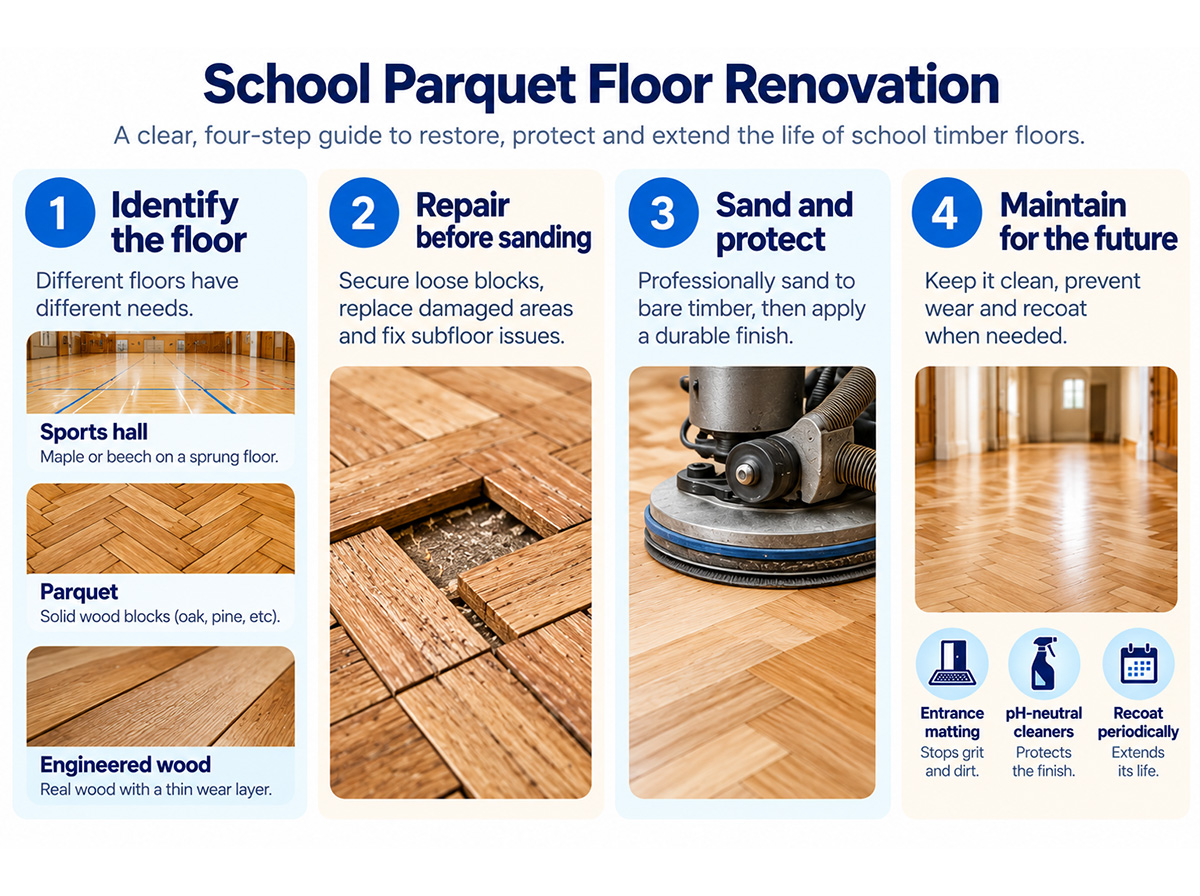
Entrance matting at every external door is the single most effective thing a school can do for its floors. The grit that comes in on shoes is responsible for the majority of surface wear — capturing it before it reaches the floor is far better than any maintenance regime after the fact.
Cleaning products matter more than most premises managers realise. Soaps and waxes leave residue that builds up over time and dulls the surface. pH-neutral products designed for sealed timber floors are what they should be using.
And a maintenance recoat — a light sand and a fresh coat of lacquer over the existing finish, before it wears through completely — every three to four years is far less disruptive and far less expensive than letting the floor deteriorate to the point where a full renovation becomes unavoidable.
Contact Floorworks™ for a Free Professional Consultation

What to Look for in a Contractor
The school that employs the cheapest contractor available for a floor renovation almost always ends up paying more in the long run. A poorly sanded surface, a wrong product choice, or an insufficient number of coats means the finish fails early — and the disruption and cost of doing the job again falls on the school.
Ask any contractor to explain their preparation process, specify exactly which products they're using and why, and provide references from comparable school or sports hall projects. A contractor who knows what they're doing will have no hesitation answering any of those questions in writing.
A school floor is a safety-critical surface that hundreds of people rely on every day. It's worth the time to get both the specification and the people right.


