
It's one of the most common questions homeowners ask when they first notice a deep gouge from a moved piece of furniture, or a series of claw marks near the doorway: "Can't a contractor just sand the area where the scratch is?"
On paper, it sounds like the most logical, cost-effective, time-saving solution. You have an isolated problem, so you want an isolated fix. Technically, a skilled professional can take a handheld sander, grind down the damaged spot until the scratch disappears, and apply a fresh coat of sealant. It's technically possible — but visually, it's almost always a disaster. Understanding why means understanding how natural timber changes over time, and why wood floor sanding only really works as a whole-room process.
Why a Single Scratch Can't Just Be Sanded Out
Wood isn't a static, synthetic material like laminate or vinyl. It's an organic surface that constantly evolves after installation. Fixing a single scratch isn't just repairing the wood — it's rewriting the history of one isolated square foot while leaving everything around it untouched. The result is usually a patch that looks worse than the original scratch ever did.
Contact Floorworks™ for a free professional consultation

How Timber Ages — and Why That Matters for Repairs
The moment a wood floor is laid and finished, a natural process called oxidation begins, accelerated by UV light. Sunlight streaming through windows subtly bakes the timber daily, gradually altering its chemical composition. Depending on the species, this either deepens and darkens the wood — as with cherry and walnut — or bleaches and lightens it, as with lighter oaks and maples.
At the same time, the protective lacquer, oil, or polyurethane on the surface is ageing too. Older oil-based finishes often develop "ambering," a slow yellowing that gives a floor a warm, distinct patina impossible to replicate straight out of a tin of fresh stain.
When a contractor sands a small patch to remove a scratch, they strip away years of this natural ageing. What's left is raw, untouched timber — essentially the exact colour the wood was the day it was milled, before any sunlight, oxygen, foot traffic, or cleaning products touched it. Even using the same brand, line, and colour code of stain, that patched area will look noticeably brighter and fresher than the surrounding floor, creating an obvious "patchwork" effect rather than a subtle, blended repair.
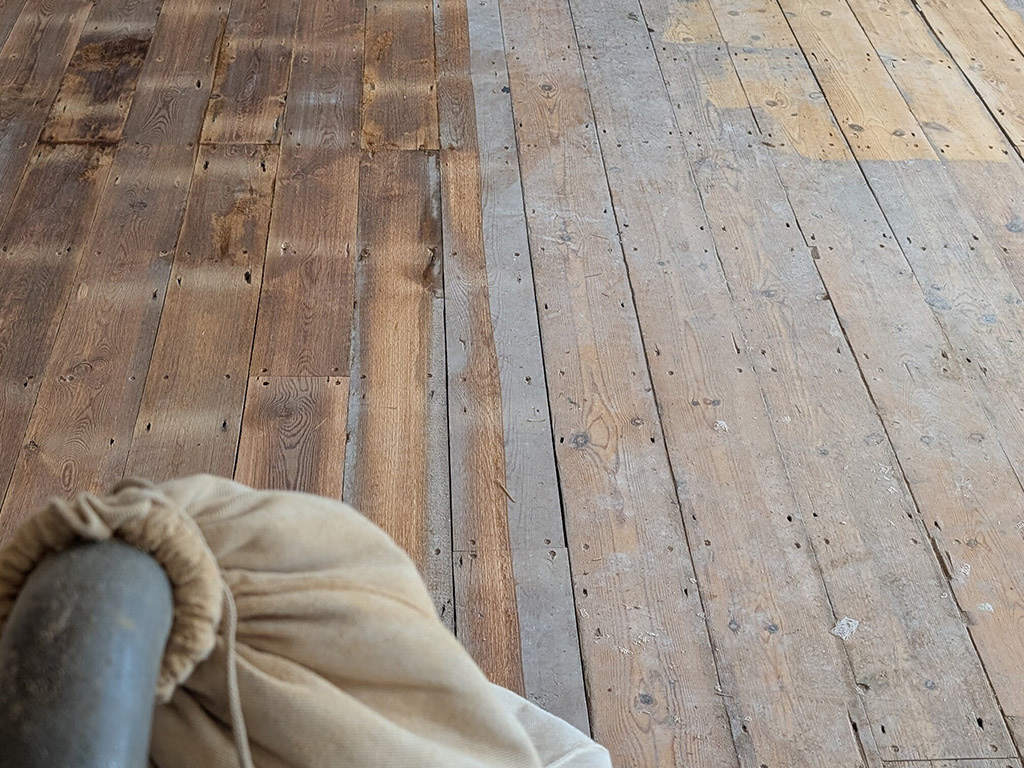
The Problem With Matching Texture and Sheen
Colour mismatch is only half the issue — texture and sheen are just as hard to match. When a floor is professionally finished as a whole, the lacquer or oil cures uniformly across the entire surface. Over the years, foot traffic and cleaning gradually dull the original gloss level, so a high-gloss floor softens to semi-gloss, and a satin finish edges closer to matte.
A fresh dab of finish on a sanded patch cures at its original sheen level — so even a tin labelled "satin" will look noticeably shinier than a decade-old satin finish. Under angled light, the patched area will either reflect like a mirror or sit flat compared to the rest of the room.
Texture is just as difficult to match at a micro level. Wood expands and contracts with seasonal humidity, creating a subtle, natural texture across the grain over time. Hand-sanding a small patch creates an unnaturally smooth, flat dip in the floor — and the human eye is very good at spotting irregularities like this, even subconsciously.
Why Full-Room Wood Floor Restoration Is the Only Seamless Fix
To get a genuinely flawless finish, the patch has to be abandoned in favour of restoring the entire continuous area. In professional wood floor restoration, "continuous area" means any space that flows uninterrupted by doorways, thresholds, or transitions — if your living room flows into your dining room with no T-moulding or threshold between them, they're treated as a single floor.
Sanding the entire room down to raw timber is the only way to reset the clock evenly. A professional floor sanding service uses heavy equipment like belt sanders and edgers across the whole space, removing aged lacquer, uneven patina, and surface imperfections all at once, returning the floor to a uniform blank canvas.
When new stain, oil, or lacquer is applied to a fully levelled, unified surface, the wood absorbs it at the same rate everywhere. Pigment penetrates evenly because porosity is consistent across the whole floor, and the topcoat cures to one identical sheen with no lap marks or visible boundaries.
This is also the foundation of a proper wood floor renovation — beyond just removing a scratch, a full sand and refinish erases invisible wear patterns, faint discolouration under old rugs, and the microscopic scuffing you might not even have noticed was dulling the room.
Spot sanding a single scratch might seem like the cheaper, faster option, but it almost always backfires — ageing, oxidation, and gradual changes in sheen mean a patched area will never blend with the rest of an older floor. The only way to get a genuinely seamless result is full-room wood floor sanding, treating the whole continuous space as one surface rather than isolating the damage. While it costs more upfront than a quick patch, a proper floor sanding service delivers an even, durable finish that protects the floor's appearance — and your home's value — for years to come, without the tell-tale "repair" patch that spot treatment leaves behind.


