
Oil or lacquer for your wooden kitchen worktop? Here's an honest comparison of both finishes — what each protects against, which suits which timber, and how to maintain both.
It's one of those questions that sounds simple until you start looking into it. Oil or lacquer? The answer you get depends entirely on who you ask — and both sides usually have good reasons for their preference.
What most people don't realise is that oil and lacquer aren't competing versions of the same thing. They're fundamentally different approaches to the same problem — protecting a natural timber surface in one of the most demanding environments in the home. One works from within the wood. The other sits on top of it. One needs topping up regularly but forgives wear gracefully. The other needs less day-to-day attention but demands professional restoration when it eventually goes. Neither is the wrong choice — but one is almost always a better fit for the specific timber, the specific kitchen, and the specific person using it.
Here's everything you need to know to make that call with confidence.
How Each Finish Works — The Fundamental Difference
- Hardwax-Oil is a penetrating product. It soaks into the cellular structure of the timber and becomes part of the wood itself rather than forming a film on top of it. Hardwax oils — Osmo, Blanchon, Woca — combine natural oils with hard waxes that fill the surface pores and create water repellency within the grain. The result looks and feels completely natural. The grain is visible and tactile, the surface has warmth and depth, and the worktop looks as though it's been barely treated at all.
- Floor Lacquer is a surface coating. It forms a hard, transparent film on top of the timber that seals the surface from above. Everything that lands on the worktop — water, cleaning products, spills, chopping — makes contact with the lacquer film rather than the wood itself. The timber beneath is sealed and protected as long as that film remains intact.
This single difference — penetrating vs surface — is what drives every other comparison between the two finishes.
The Honest Comparison
Appearance
Oil produces a finish that looks like the timber itself — low sheen, tactile, warm. The natural character of the grain comes through clearly and the surface invites touch rather than keeping it at arm's length. Lacquer produces a more defined, uniform surface — cleaner in appearance, slightly higher sheen, more obviously "finished." Both can look exceptional. They suit different kitchen aesthetics: oil for kitchens where natural warmth and character are the priority, lacquer for kitchens where a crisper, more refined look is the goal.
Day-to-Day Durability
Lacquer is more durable in everyday use. The hard surface film resists scratches, moisture, and the everyday demands of a working kitchen more effectively than an oiled surface. An oiled worktop that's been recently re-oiled performs well — but between maintenance events, it's more vulnerable than a lacquered equivalent in good condition.
What Happens When It Gets Damaged
This is where the two finishes diverge most significantly — and it's the consideration most people don't think about at the point of choosing.
An oiled worktop that's scratched or showing localised wear can be lightly sanded in that area and re-oiled. The repair blends naturally with the surrounding surface because both are the same material — oil in timber. The result is invisible.
A lacquered worktop that's scratched or worn in one area cannot be spot-repaired invisibly. New lacquer applied over an isolated patch looks different from the aged lacquer around it — the sheen level, the colour, and the texture don't match. A full professional strip and refinish is the only way to produce a uniform result. For more on what that process involves, see our restoration and maintenance guide.
Maintenance Commitment
Oil requires regular top-ups to stay effective — the oil depletes gradually as it protects the surface, and it needs replenishing before the timber becomes vulnerable. Most oiled worktops benefit from a light application of maintenance oil every few months and a full light sand and re-oil once a year. This is a commitment, and it has to happen on schedule.
Lacquer requires far less routine attention — the film protects without any homeowner intervention until it eventually wears. But when professional restoration is needed, it's more involved than an annual re-oil.
Switching Between Finishes
Worth knowing: at the point of professional restoration, the finish type can be changed. An oiled worktop that's been hard to maintain can be restored and switched to lacquer. A lacquered surface that's felt too clinical can be stripped and re-done in oil. The timber doesn't dictate a permanent finish commitment — the restoration is the opportunity to reconsider.
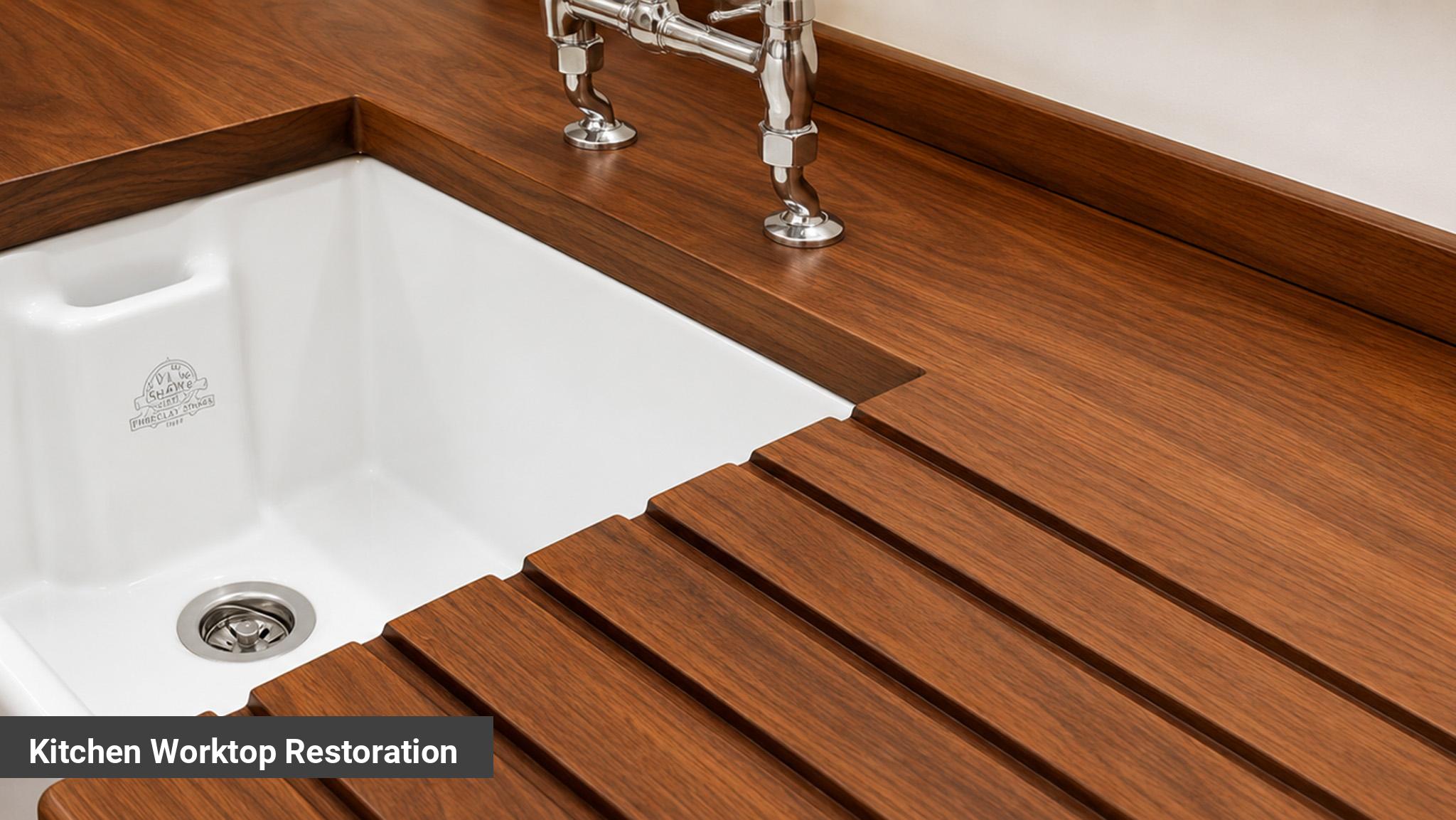
Which Finish Suits Which Timber — A Quick Reference
Different timber species have natural properties that make one finish a better fit than the other. This isn't a hard rule — both finishes can be applied to most timbers — but it's a useful starting point.
- Oak — suits both finishes well. Oil develops the natural grain beautifully over time. Lacquer provides stronger day-to-day protection in busy kitchens. The iron-tannin reaction that causes dark staining around sinks is common on oak — a well-maintained lacquer film offers better protection in this zone.
- Walnut — typically lacquered. Softer than oak, so the harder protection of lacquer is the more practical choice. The rich, dark character of walnut shows well under a clear lacquered finish.
- Cherry — typically lacquered. A relatively soft timber prone to scratches and dents — the lacquer film slows the rate at which these accumulate. Ages beautifully under lacquer as it develops its characteristic deeper patina.
- Teak — naturally oiled. Teak contains oils within the timber itself that contribute to its exceptional moisture resistance. The applied oil works with these natural oils rather than against them. Lacquer on teak can be difficult to bond correctly due to the natural oil content.
- Ash — typically lacquered. A distinctive grain pattern and light colour that benefits from the sealed protection lacquer provides. Requires regular sealing to prevent water damage.
Contact Floorworks™ for Premium Flooring Products

The Products We Use
- For oiled worktops: Osmo Polyx Hardwax-Oil is our the most-used product for worktop oiling. It is food-safe once fully cured, providing genuine moisture resistance, and maintaining the natural quality of the timber that oiling is chosen for. For high-use worktops, we use products specifically formulated for worktop applications rather than standard floor oils — the formulation accounts for the demands of a food preparation surface.
- For lacquered worktops: Water-based lacquers are the right choice — they don't yellow over time, which matters on lighter timbers like maple, beech, and ash, and they're food-safe once cured. The same principle applies as for floor lacquers — the quality of the product and the number of coats determine how long the finish lasts before professional restoration is needed.
After the Finish Is Applied — The Maintenance Difference in Practice
This is where the real-world implications of the finish choice play out.
- With an oiled worktop, the maintenance responsibility sits with the homeowner day to day. The right cleaning products matter — pH-neutral, wood-friendly, nothing abrasive or bleach-based. Spills need to be wiped up promptly. The maintenance oil needs to be applied regularly. Our re-oiling service covers worktop re-oiling where a professional result is preferred — but for most homeowners with an oiled worktop, the annual maintenance is manageable with the right product and a bit of time.
- With a lacquered worktop, the day-to-day maintenance is simpler — the right cleaner, prompt spill management, heat protection. The professional restoration comes less frequently, but when it comes it requires calling someone in. The signs that restoration is needed are: the surface dulling noticeably despite cleaning, scratches accumulating faster than before, or visible wear through the film in high-use areas. Don't wait until bare timber is exposed — the worktop restoration service is less invasive and less expensive when the lacquer is worn rather than gone entirely.
Contact Floorworks™ for Professional Flooring Solutions
Oil and lacquer protect wooden kitchen worktops in fundamentally different ways — and the right choice comes down to the timber species, how the kitchen is used, and the maintenance commitment available. Oil is the more natural finish, more forgiving of localised damage, and better suited to timbers like teak and iroko with natural oil affinity. Lacquer provides stronger day-to-day protection with less routine maintenance, suits most lacquer-friendly timbers well, and is the better specification for busy kitchens where durability matters more than repairability.
What both finishes have in common is that they need to be applied correctly to a properly prepared surface — and that the restoration or re-application, when it comes, needs to be done right. At Floorworks, our worktop restoration service covers both finish types across all the main worktop timber species. Get in touch for a free assessment — we'll look at the worktop, the timber, and how the kitchen is used, and give you an honest recommendation before any commitment is made.


