
A wooden kitchen worktop is one of the most satisfying surfaces you can have in a home — warm, characterful, genuinely beautiful when it's in good condition. It's also one of the most punished. Chopping, hot pans, spills, cleaning products applied too aggressively, water sitting around the sink — over time, all of it takes its toll. The finish dulls, scratches accumulate, dark watermarks appear around taps and sinks, and what once looked like a feature becomes something you're trying to work around.
The good news is that a wooden worktop rarely needs replacing. Unlike laminate or composite surfaces that have to come out when they're damaged, timber can be sanded back and started again — often more than once over its lifetime. The same material properties that make wood vulnerable to surface damage are what make it restorable. Understanding how that process works, and what the right maintenance looks like once it's done, is what this article is about.
Oiled vs Lacquered: The Distinction That Changes Everything
Before talking about restoration or maintenance, the most important thing to establish is how the worktop is finished — because the answer determines every decision that follows.
- Oiled worktops are protected by a penetrating oil — hardwax oil products like Osmo or Blanchon are common — that soaks into the timber rather than sitting on top of it. The oil feeds the wood and provides protection, but the surface remains relatively open — which means moisture can penetrate if spills aren't wiped up quickly, and the finish needs topping up periodically to stay effective.The practical advantage of an oiled finish is maintenance — a worktop that's oiled regularly is easier to look after and easier to restore when it's showing wear. Light sanding and re-oiling is usually all that's needed for most signs of wear and minor watermarks. Most oiled worktops benefit from light sanding and re-oiling once a year, depending on how much use the kitchen gets.
- Lacquered worktops are sealed with a hard protective film that sits on top of the timber. The lacquer provides a more durable surface that takes longer to show wear — it resists moisture and everyday use better than oil in the short term. The trade-off is what happens when it eventually does wear or get damaged: a lacquered worktop can't simply be topped up the way an oiled one can. The lacquer has to be completely stripped back — which means full sanding — before a new sealant can be applied. This is a more involved process and is best left to a professional worktop restoration service.
If you're not sure which finish your worktop has, a simple test helps: apply a small amount of water to an inconspicuous area and watch what happens. If the water beads and sits on the surface, the worktop is lacquered. If it soaks in slightly and darkens the wood, the finish is oil.
The Most Common Problems — and What Causes Them
Understanding what's actually happening to the surface helps diagnose what the restoration needs to address.
- Surface scratches. The most common complaint. Fine scratches from chopping, cutlery, and everyday use accumulate in the finish and give the surface a dull, worn appearance that cleaning doesn't fix. On an oiled worktop, light sanding and re-oiling usually addresses these. On a lacquered surface, spot-treating a single area is almost impossible to do invisibly — the new finish looks different from the old, aged lacquer around it. A full strip and refinish is the only way to achieve a uniform result.
- Watermarks and dark staining around the sink. Water that sits around taps and sink edges penetrates the timber and causes dark staining that can be very difficult to address without proper restoration. For very dark watermarks or iron stains — the black marks that appear when iron in the water reacts with tannins in the timber — oxalic acid (wood bleach) can be effective when used correctly as part of the sanding and preparation process. This isn't a DIY treatment on a kitchen worktop — it requires care and proper neutralisation before any new finish goes on.
- Burn marks and heat damage. A hot pan placed directly on a wooden worktop leaves a mark that penetrates below the surface finish and into the timber itself. Depending on the depth, these can sometimes be sanded out — but deep burns may require the affected section to be cut out and replaced before the rest of the worktop can be restored uniformly.
- A finish that's worn through entirely. A lacquered worktop where the protective film has worn through in high-use areas — around the hob, at the edges, or where the most chopping happens — has lost its protection entirely in those zones. Bare timber in a kitchen absorbs every spill, every splash, and everything that touches it. This is the point where professional restoration is needed rather than maintenance.
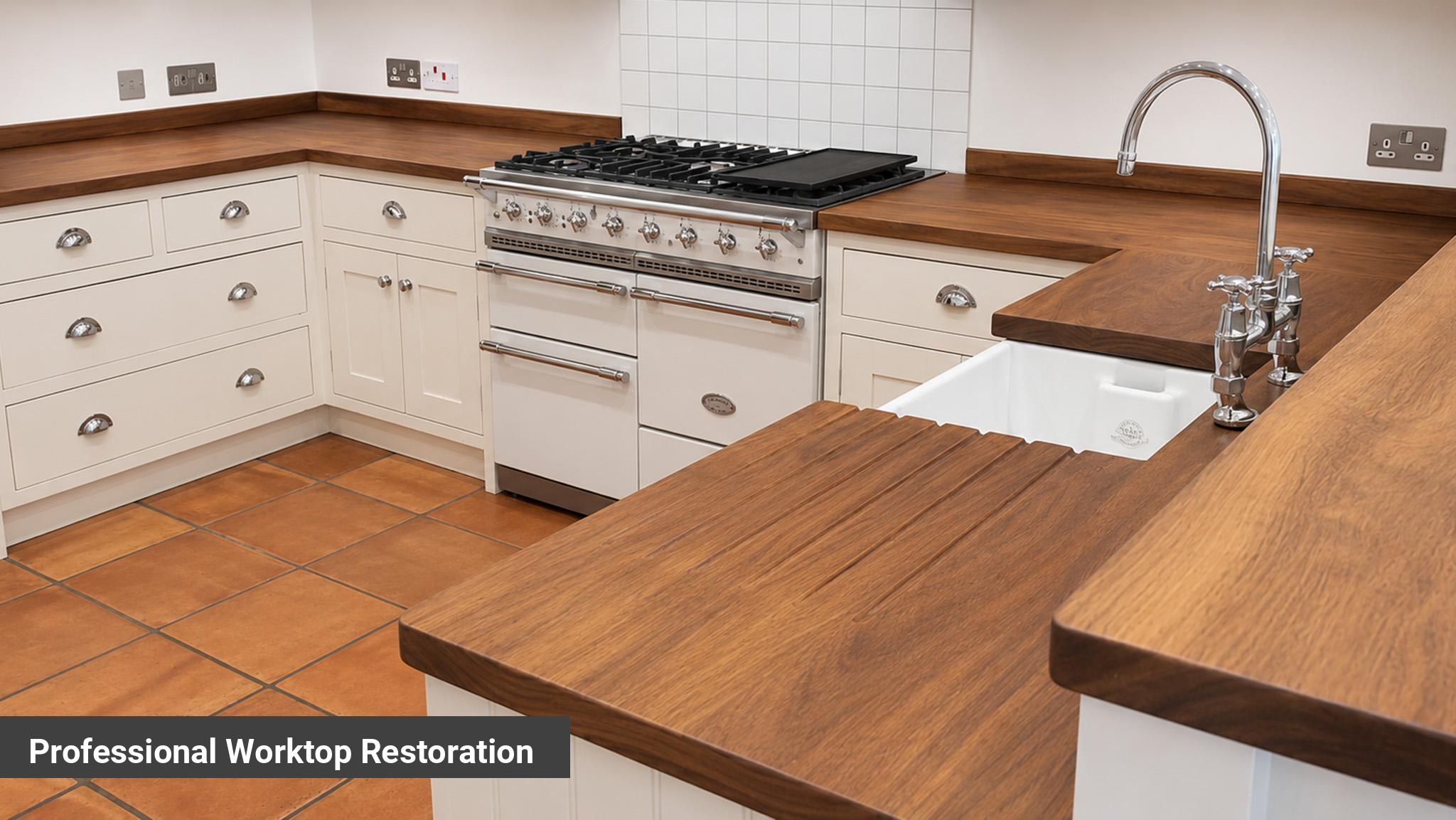
The Restoration Process: What Actually Happens
Whether it's an oiled or lacquered worktop, professional restoration follows the same fundamental sequence.
- Thorough cleaning first. Before any sanding begins, the worktop surface has to be clean and free of contamination — grease, food residue, cleaning product buildup. Sanding over a contaminated surface drives the contaminants deeper into the wood rather than removing them. This is the preparation step that most people underestimate, and it's what ensures the new finish bonds properly.
- Sanding back to bare timber. For lacquered worktops, the existing finish has to be completely removed before any new sealant is applied — not just abraded, fully stripped. For oiled worktops requiring restoration rather than simple maintenance, the same principle applies: the old, degraded oil layer is sanded away to expose clean timber that will absorb a fresh coat evenly. The sanding process works through progressively finer grits until the surface is smooth and consistent. Dark watermarks, staining, and surface damage are addressed at this stage — either through sanding alone or, for more stubborn staining, through targeted treatment before the final sanding passes.
- Treatment of stains and damage. Watermarks, dark staining, and any structural repairs needed are addressed before the final finish goes on. Attempting to finish over a stain without removing it produces a result that looks patchy and uneven — the stain shows through.
- Application of the new finish. The finish choice — oil or lacquer — is applied in the right number of coats for the specific timber species and the level of use the worktop will receive. Each coat is allowed to cure properly before the next is applied.
At Floorworks, our worktop restoration service follows this process on every project — and we also restore wooden table tops, bar countertops for restaurants and pubs, and some types of furniture using the same principles. The worktop in a kitchen and the bar counter in a restaurant are different scales of the same problem: a timber surface that's been damaged by daily use and needs to be brought back.
In a recent project in Thames Ditton, we carried out both engineered oak floor restoration and kitchen worktop restoration in the same property — the combination is one we come across regularly, since a kitchen renovation that addresses the worktops and the floor together produces a much more cohesive result than tackling them separately at different times.
Popular Worktop Timbers and What Each One Needs
Different timber species respond to wear, moisture, and restoration differently. Understanding the characteristics of your specific worktop species helps set realistic expectations.
Oak
Oak is the most popular worktop timber in the UK — dense, durable, and with a grain that takes both oil and lacquer finishes well. Oiled oak worktops require light sanding and re-oiling once a year to maintain the protective finish. Lacquered oak worktops are more durable day-to-day but require professional restoration when they eventually wear — the lacquer has to be fully stripped before a new sealant can go on.
Oak is also susceptible to the iron-tannin reaction that produces dark black staining around sinks and taps — particularly in areas with hard water. This staining is one of the most common reasons oak worktops come to us for restoration, and it's addressable through the sanding and preparation process.
Walnut
Walnut is typically lacquered rather than oiled — its rich, dark character is well suited to a lacquered finish that shows off the grain clearly. Being softer than oak, walnut dents and scratches more easily, which makes the harder protection of lacquer the more appropriate choice for a working kitchen surface. When the lacquer eventually wears, professional restoration is needed — the same full strip and refinish process that applies to any lacquered worktop. Walnut's darker tone makes surface marks less immediately obvious than on lighter timbers, but it still needs proper maintenance to stay looking its best.
Cherry
Cherry is a relatively soft timber that shows scratches and dents more readily than oak or iroko, which makes lacquer the natural finish choice — the hard film slows the rate at which surface damage accumulates. One of the most distinctive qualities of cherry is how it ages: it deepens and enriches in colour significantly over time, developing a warm, reddish-brown patina that makes it look genuinely better as the years pass. A lacquered cherry worktop allows that natural colour development while keeping the surface protected. Professional restoration is recommended when the finish wears.
Ash
Ash has a distinctive, pronounced grain pattern and a light, pale tone that gives it a clean, contemporary quality. It comes typically lacquered — ash requires regular sealing to prevent water damage and staining, and a well-maintained lacquer film is the most reliable protection for a kitchen environment. The relatively open structure of ash makes it more susceptible to moisture penetration when unprotected, so keeping the finish intact matters more with ash than with denser species. Professional restoration is recommended when the lacquer wears, and the light colour makes any staining or watermarks more visible than on darker timbers — which is an additional reason to address wear promptly rather than leaving it.
Teak
Teak occupies a unique position among worktop timbers because of its natural oil content — it contains oils within the timber itself that contribute to its exceptional moisture and stain resistance. This makes oiled teak the natural specification: the applied oil works with the timber's inherent properties rather than trying to compensate for a vulnerability that isn't there. Annual re-oiling maintains the surface and keeps the natural oils replenished. Lacquer is less common on teak and can be more difficult to apply correctly given the natural oil content, which can affect adhesion — this is a case where a professional assessment before choosing a finish is particularly worthwhile.
Contact Floorworks™ for High-Quality Flooring Products

Finish Options After Restoration
The same finish principles that apply to timber floors apply to timber worktops — with one additional consideration: worktops are food preparation surfaces, so the products used need to be food-safe once cured.
- Hardwax oils — Osmo Polyx, and similar products — are the most commonly used finish for restored oiled worktops. They penetrate the timber, provide good moisture resistance, and are food-safe once fully cured. The low-sheen result is natural and warm. For worktops that take sustained heavy use, a product specifically formulated for worktops — rather than a general floor oil — provides better protection.
- Lacquers — for worktops that need the harder, more protective finish that oil can't provide. Water-based lacquers are the right choice — they don't yellow over time (which matters on light-coloured timbers like maple and beech), and they're food-safe once cured. The finish is harder and more resistant to everyday wear than oil, but a lacquered worktop that shows damage needs professional refinishing rather than a simple top-up.
The choice between oil and lacquer at restoration is also an opportunity to change the finish type if the original choice wasn't working. An oiled worktop that's consistently been damaged by moisture around the sink can be switched to lacquer at restoration — and vice versa, if a lacquered worktop's maintenance requirements are inconvenient and an oiled finish would suit the kitchen better.
Maintenance: What Keeps a Restored Worktop Looking Good
A worktop restoration is an investment — and what happens in the months and years after it determines how long the result lasts.
- Clean daily with the right products. A soft cloth and a mild, wood-friendly cleaner is all that's needed for routine cleaning. Avoid anything abrasive, anything that contains bleach, and anything labelled as a multi-surface cleaner — these products strip away protective oils and lacquers gradually without any visible sign of the damage until it's already been done.
- Wipe up spills immediately. This applies to both oiled and lacquered worktops, but especially to oiled ones where the surface is more open. Water sitting around taps, coffee spills, wine — all of these need to be wiped up quickly rather than left to dry. The most persistent watermarks and stains on timber worktops develop from liquids that were left rather than spills that happened.
- Oil regularly if the worktop is oiled. A light application of the appropriate hardwax oil — once a year for most kitchens, more frequently if the worktop takes heavy use — keeps the timber fed and the protective finish effective. This is the maintenance step most people skip until the worktop is already showing wear, at which point a full restoration is needed rather than a top-up.
- Use a chopping board. It sounds obvious, but the difference between a worktop that still looks great after ten years and one that needs restoration in three is largely this. Cuts directly into the surface damage it in ways that both oil and lacquer prevent only so much. A chopping board protects the surface and keeps the finish where it's needed.
- Protect against heat. Never place hot pans directly on a wooden worktop. A trivet or heat mat under anything coming off the hob or out of the oven is a simple step that prevents the burn marks that require the most invasive restoration to address.
When to Call a Professional
Some worktop maintenance — regular re-oiling of an oiled surface, light cleaning, using the right products — can be managed by the homeowner. The point at which professional restoration is needed is usually clear.
If the lacquer has worn through entirely in high-use areas, the worktop needs professional restoration — re-lacquering over a damaged surface doesn't produce a durable result and won't bond correctly. If the worktop has dark watermarks or iron staining that surface cleaning hasn't addressed, professional sanding and targeted treatment is what removes it. If there are burn marks, significant scratches that have penetrated well below the finish, or sections of timber that have been damaged structurally, professional assessment determines what's needed before any restoration work begins.
At Floorworks, our worktop restoration service covers all of these situations. We assess every worktop individually — looking at the species, the current finish, the nature of the damage, and what the restoration needs to achieve — and give an honest recommendation of what's possible before any work is agreed.
The same care and precision we bring to wood floor restoration applies to worktops — the principle of removing the minimum material needed to achieve the result, using the right finish for the species and the use, and leaving the surface properly protected going forward.
Contact Floorworks™ for Professional Flooring Solutions
Wooden kitchen worktops scratch, stain, and lose their finish over time — but they don't often need replacing. The same material that makes timber susceptible to damage is what makes it restorable: it can be sanded back, treated, and refinished to a standard that's close to new, often more than once across its lifetime. The distinction between oiled and lacquered worktops determines the maintenance approach and the point at which professional restoration is needed. Regular re-oiling for oiled surfaces, the right cleaning products for both, and prompt attention to spills and heat damage are what extend the time between professional restorations.
When restoration is needed — and the signs are usually clear — Floorworks offer professional worktop restoration across London, covering oak, beech, maple, and other popular worktop species. We also restore wooden table tops and bar countertops for restaurants and pubs where the same daily demands produce the same results over time.
Get in touch for a free assessment — we'll look at the worktop, establish what it needs, and give you a clear picture of what restoration can realistically achieve.


