
Sports hall floors work harder than almost any other commercial surface. Daily foot traffic, abrupt movement, heavy equipment, and constant cleaning gradually strip away protective finishes and expose the timber beneath. For schools, leisure centres, and professional venues across London and the South East, keeping that surface in safe, professional condition requires more than reactive repairs — it requires a structured approach to both restoration and ongoing care.
When Does a Sports Hall Floor Need Professional Restoration?
The signs are usually gradual. Finish wears thin in high-traffic zones first, leaving dull or discoloured patches across the court. Court markings begin to fade or bleed at the edges. Gaps appear between boards as seasonal humidity causes the timber to expand and contract. In parquet floors, individual blocks can lift or loosen entirely.
These are not cosmetic problems. A floor with uneven grip, raised edges, or exposed timber presents a genuine safety risk. When these signs appear, routine cleaning can no longer compensate — the floor needs professional wood floor sanding to strip back the damaged layers and restore a stable, consistent surface.
Hardwood floor sanding removes worn finish, smooths imperfections, and prepares the timber for refinishing. For parquet floors, parquet floor sanding requires additional care — the interlocking geometry of the blocks means sanding must follow the correct direction and pattern to avoid tearing the grain. Floorboards floor sanding follows a more straightforward linear approach, though edge sanding still demands precision where the perimeter meets the main floor area.
The Restoration Process: From Repairs to Finishing
Professional wood floor restoration always begins with structural assessment. Sanding over loose or damaged sections makes problems worse, not better. Before any equipment moves onto the floor, a specialist will identify areas requiring hardwood floor repairs, parquet floor repairs, floorboards repairs, or gap filling where movement has created uneven joints between boards.
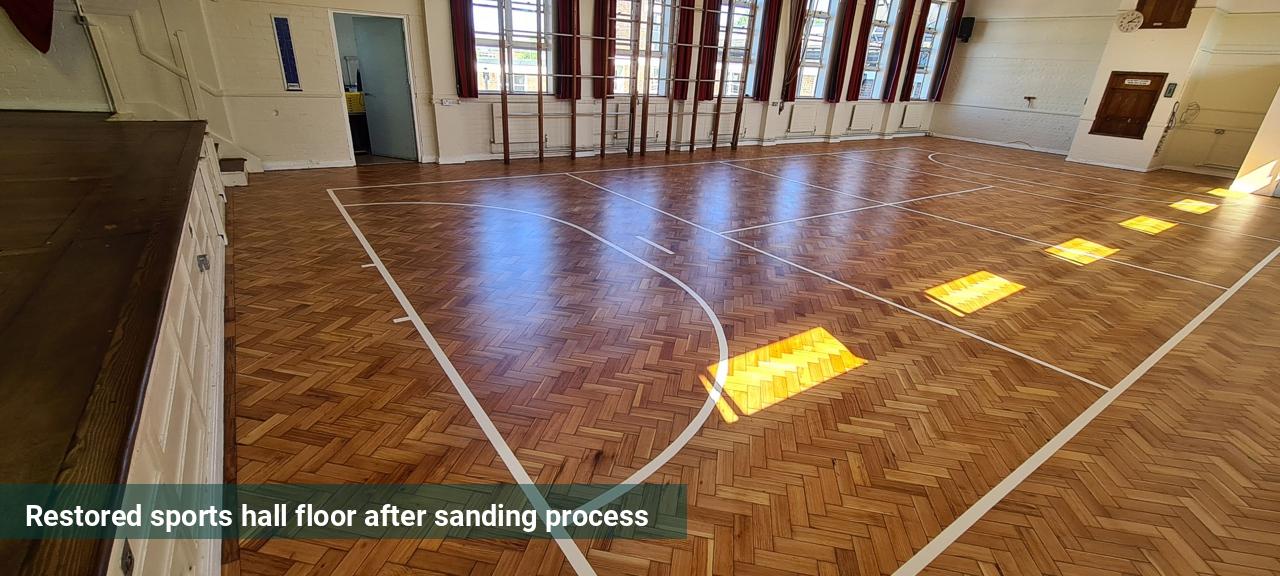
Once repairs are complete, the floor sanding service removes the worn surface layer to reveal fresh, consistent timber ready to accept a new finish. At this stage, wood floor staining can be applied where the existing timber has faded unevenly or lost its original tone — floor staining creates a uniform base and refreshes the character of older floors before the protective coats go on.
The final stage is finishing. The right choice depends on usage level and maintenance capacity. Re-oiling wooden floors suits facilities that want a natural appearance and the ability to carry out localised spot repairs between major works — wood floors oiling penetrates the timber rather than sitting on top, making it forgiving over time. Waxing wooden floors achieves a similar look with a softer sheen, though it requires more frequent attention. For higher-traffic venues, a hard lacquer provides greater resistance to moisture and surface wear and delivers the sharp, consistent finish that court markings require to remain legible.
We guide sports hall managers through this decision based on the specific flooring type, level of use, and realistic maintenance commitment — so the finish chosen is one the facility can actually sustain.
Ongoing Maintenance: The Schedule That Protects the Investment
Restoration is only half the equation. A newly refinished floor can deteriorate rapidly without consistent care — and the cost of deferred maintenance is always higher than the cost of preventing it.
Daily, the floor should be dust mopped to remove grit and shoe debris. These fine particles are abrasive and strip finish faster than almost anything else. Spills must be addressed immediately; moisture sitting on a timber floor, even briefly, can cause swelling and adhesion failure beneath court markings.
Weekly, a damp clean using a pH-neutral, manufacturer-approved sports floor cleaner removes oil residue and deeper grime. The emphasis is on damp — excess moisture is timber's primary enemy. A proper floor sanding service provider will always recommend specific cleaning products compatible with the finish applied.
Monthly, a condition check should assess grip levels, court marking integrity, and any early signs of board movement or finish failure. If localised areas are showing wear, polishing wooden floors in those zones with an appropriate maintenance polish can extend the life of the existing coating until annual works are due. Floor polishing is not a substitute for restoration, but as part of a structured schedule it is a cost-effective way to protect the surface between major projects.
Annually, the floor should undergo a screen-and-recoat for lacquered surfaces — a light abrasion of the existing finish followed by a fresh topcoat that restores grip and gloss without requiring a full wood floor sanding. For oiled floors, the annual programme involves a deep clean and a full maintenance coat, the process known as re-oiling wooden floors in a maintenance context. Court markings should be repainted at this stage before the final coat seals them in.
The Cost of Getting It Wrong
Facilities that skip daily dust mopping accelerate finish wear by years. Those that defer annual maintenance eventually face the full cycle of wood floor renovation — sanding, repairs, staining, and refinishing — far sooner than necessary. A floor on a proper maintenance schedule will typically last ten to fifteen years between major hardwood floor restoration projects. A neglected one may need the same work in three to five.
We have carried out wood floor restoration and ongoing maintenance for sports halls across London and the South East for years. Whether the floor is traditional parquet, hardwood, or timber floorboards, the principle is the same: consistent care costs less, performs better, and keeps athletes safer than any amount of reactive repair work.
If your sports hall floor is showing signs of wear, or if you want to put a maintenance programme in place before problems develop, contact us for an assessment.


