
The Mirka DEROS RS & DEROS II look similar, but do very different jobs. Here's an honest comparison of both machines — what each does, when to use which, and why having both changes the quality of the work.
If you've spent any time looking at professional sanding equipment, you'll have come across the Mirka DEROS family. Both the DEROS RS and the DEROS II 650 come from the same manufacturer, look superficially similar, connect to the same dust extraction systems, and use the same 150mm backing pad. But they are fundamentally different tools — different mechanisms, different purposes, different results. Using one where the other is needed produces outcomes that range from disappointing to genuinely damaging.
This article explains exactly what each machine is, what it does, when to reach for it, and why the distinction matters in real-world flooring and restoration work.
The Fundamental Difference: Rotation vs Oscillation
Before getting into applications and scenarios, the mechanical difference between these two machines is what everything else flows from.
- The Mirka DEROS RS is a rotary sander. The pad spins — continuously, in one direction — which is what gives it its aggressive stock removal capability. Rotary action is the most powerful form of sanding, capable of cutting through old lacquer, paint, thick finishes, and heavily contaminated surfaces faster than any orbital machine. The RS stands for Rotary Sander, and the name tells you exactly what it is.
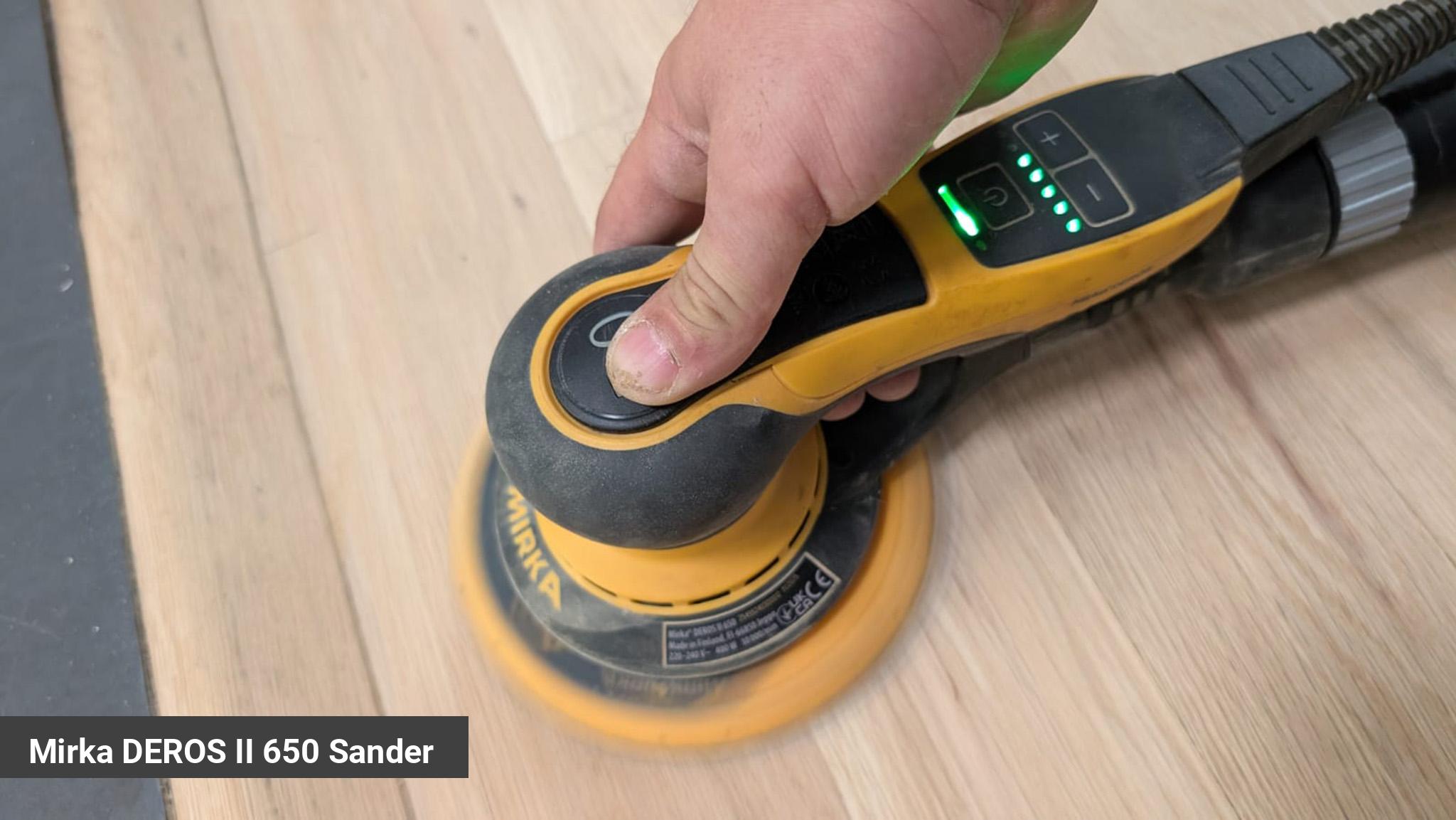
- The Mirka DEROS II 650 is a random orbital sander. The pad oscillates in a random, unpredictable pattern — a combination of rotation and eccentric movement that means no single part of the pad traces the same path twice. This random motion is what prevents the circular scratch marks that a purely rotary sander leaves in the surface, producing a significantly finer, more consistent result as the final finish approaches.
The sanding world uses both mechanisms because they solve different problems at different stages of the same job. The DEROS RS removes material fast. The DEROS II 650 prepares the surface for coating.
Mirka DEROS RS 600: The Heavy-Duty Machine
What It Is?
The DEROS RS is a 750-watt brushless rotary sander weighing just 1.8kg — remarkable given its power output. It operates at between 700 and 2,500 rpm across six speed settings, controlled by clearly visible LED indicators identical to those on the DEROS II. The rotary disc is enclosed in a shroud that contains dust at the point of generation, connecting to standard Mirka dust extraction systems for genuinely dust-free operation even during heavy stock removal.
Despite the significant power, the RS is notably quiet and low in vibration for a machine in its class — a combination that makes extended periods of use genuinely manageable rather than fatiguing.
What It Does?
The DEROS RS is built for situations where material has to come off fast. Old lacquer that's been applied in multiple coats over decades. Thick paint finishes that standard orbital machines struggle to cut through efficiently. Heavily contaminated surfaces — floors in restaurants, pubs, or commercial spaces where cleaning products, cooking grease, or oil have built up within the finish. Rough timber that needs levelling before any finishing work can begin.
The rotary action cuts aggressively through all of these. Starting with a coarser grit — P40, P60 — the RS strips the surface back to bare or near-bare timber far faster than an orbital machine could manage on the same material. This speed isn't just about efficiency. On a commercial floor where time closed is revenue lost, a machine that removes the old finish in one pass rather than three is a meaningful operational advantage.
When to Use It in Flooring and Restoration Work
- Initial stripping of heavily finished floors. Restaurant and pub floors that have been lacquered multiple times without full restoration between applications carry a significant build-up of finish. The DEROS RS cuts through these efficiently without the repeated passes an orbital machine needs.
- Old paint or heavily contaminated surfaces. Floors that have been painted, stained with aggressive products, or had non-standard finishes applied — particularly in commercial or older residential properties — need the rotary action to remove the contamination fully before any new finish will bond correctly.
- Levelling rough or uneven timber. Decking, solid timber surfaces that have cupped or moved, and wood that needs significant material removed to reach a level plane all benefit from the RS's aggressive cutting action.
- Worktop and surface restoration. Kitchen worktops that have deep staining, worn-through lacquer with embedded grime, or surfaces contaminated with oils and food residues are exactly the kind of material the DEROS RS was designed for — it removes the problem layer fast, leaving a clean surface ready for the DEROS II to refine. This connects directly to our restoration and maintenance of wooden kitchen worktops — the preparation stage before any new oil or lacquer goes on.
- Stairs and other accessible flat surfaces. The RS is a handheld machine at 1.8kg — light enough to use comfortably on stair treads, decking sections, and any surface that's accessible but doesn't justify a large floor drum sander. For our stair restoration service, the DEROS RS handles the initial stripping of old lacquer from treads effectively before the DEROS II refines the surface.
What It Doesn't Do?
The DEROS RS is not a finishing machine. The rotary action leaves circular scratch marks in the surface that are completely unacceptable under any clear finish — lacquer or oil. These marks don't disappear when the finish is applied. They become more visible. The RS takes the surface to a point where it's clean, level, and free of old finish. What happens after that point requires a different tool.
Mirka DEROS II 650: The Finishing Machine
What It Is?
The DEROS II 650 is a 150 mm random orbital sander with a 5 mm oscillation — the most commonly used orbit size, which achieves a good balance between stock removal and surface finish quality. It runs on a high-efficiency brushless motor that maintains consistent speed across varying load conditions, with clearly visible LED speed indicators and a separate on/off switch that makes operation straightforward even in awkward positions.
At its operating weight, the DEROS II is light and balanced enough to use comfortably in orientations the DEROS RS can manage but wouldn't feel as natural in — held at angles, working into corners, used on vertical surfaces. Bluetooth connectivity allows integration with the myMirka app for vibration monitoring, which becomes relevant when the machine is used for extended periods in confined or awkward positions.
What It Does?
The random orbital action of the DEROS II 650 produces the kind of surface that takes a finish properly. The unpredictable oscillation pattern means no circular marks, no grain lines, no consistent scratch direction — just a uniformly abraded surface that lacquer or oil can bond to and flow across evenly.
Working progressively through finer grits — from 80 through 120 and beyond — the DEROS II removes the marks left by the DEROS RS and prepares the timber to the standard a professional finish requires. This is the machine that determines what the finished floor looks and feels like. The RS determines how quickly the preparation is done. The DEROS II determines the quality of what the preparation produces.
When to Use It in Flooring and Restoration Work
- Final preparation before finishing. After the DEROS RS has stripped the heavy material, the DEROS II takes over — progressing through medium to fine grits until the surface is smooth, consistent, and ready for lacquer or oil. On an engineered floor sanding project where the top layer is thin and every micron matters, the DEROS II's controlled, consistent action is exactly what's needed to prepare the surface without removing unnecessary material.
- Stairs and vertical surfaces. The DEROS II is the machine of choice for stair treads, risers, and any surface where the geometry makes a larger drum sander impractical. Its size, weight, and balance make it genuinely controllable in these situations. It can be held at angles, used with one hand for positioning while the other guides the work, and operated comfortably on surfaces that aren't perfectly horizontal. Our stair stripping and restoration service relies on the DEROS II for exactly this reason.
- Between-coat sanding on lacquered surfaces. After the first coat of lacquer or oil has been applied and cured, a light pass with the DEROS II at a fine grit flattens any grain raise or minor dust contamination before the next coat goes on. This is particularly important on the first coat over bare timber, where the water-based lacquer raises the grain and the surface needs to be brought back to smooth before the second application.
- Parquet and detail sanding. The DEROS II handles the tight areas and detail work that larger drum sanders can't reach — around radiator pipes, in corners, along the edges where the main machine doesn't go. For parquet floor restoration, the combination of main machine and DEROS II for edge and detail work is the standard approach.
- Any surface where finish quality is the priority. The DEROS II is the right tool whenever the result needs to be good enough to put a finish on. Low-key maintenance sanding, preparation for staining, refreshing the surface between professional restorations — all of these suit the controlled, consistent action of the orbital machine.
The Two-Machine Workflow: Why Both Matter
The most revealing thing about these two machines isn't what each one does independently — it's what they achieve in combination.
A professional restoration of a heavily finished floor follows a logical sequence: the DEROS RS strips the old finish aggressively and quickly, cutting through years of lacquer and contamination to reach clean timber. The DEROS II then takes that clean but rough surface and refines it — progressively, through increasing grits — until it's ready for finishing. Neither machine can do both jobs well. The RS can't finish. The DEROS II can't strip a heavily built-up finish in a reasonable time frame.
This two-stage approach is exactly what the Restorate review of the DEROS RS notes: the rotary machine removes the need for a belt sander followed by an orbital — a single tool handles the heavy stock removal, after which the DEROS II takes over. The result is a more efficient process with fewer machines, less setup time, and better control over the amount of material being removed at each stage.
At Floorworks, this workflow applies across our wood floor sanding service — from parquet restoration and floorboard sanding through to worktop renovation and stair restoration. The specific machines used at each stage vary with the nature of the surface and the condition it's in — but the principle of matched tools for matched stages is what produces results that last.
Quick Reference: Which Machine for Which Job?
- Reach for the DEROS RS when the surface has multiple coats of old lacquer to strip, paint or heavily contaminated finish to remove, rough or cupped timber that needs levelling, a worktop that needs stripping before restoration, or decking that needs aggressive initial passes. It's also the right machine for the stripping stage on stairs — fast, controlled, and dust-free even on the heaviest finishes.
- Reach for the DEROS II 650 when the stripping is done and the surface needs refining before a finish goes on. Between-coat sanding on lacquered surfaces, final preparation before oil or lacquer is applied, parquet edge and detail work that larger machines can't reach, engineered floor surface preparation where material removal has to be minimal and controlled, and any vertical or overhead surface where the machine needs to be held at angle comfortably for extended periods. On stairs, the DEROS II handles the finishing passes after the RS has done the stripping — the two machines working in sequence rather than in competition.
Contact Floorworks™ for a Free Professional Consultation

The Mirka DEROS RS and DEROS II 650 are complementary tools, not competing ones. The RS is the heavy-duty rotary machine that removes material fast — stripping old finishes, levelling surfaces, cutting through contamination — in a dust-free, low-vibration package that's genuinely comfortable to use for extended periods at 1.8kg. The DEROS II 650 is the precision finishing machine that prepares surfaces for coating — consistent orbital action, controlled stock removal, and the surface quality that professional lacquer and oil finishes require.
Neither does the other's job well. Together, they cover every stage of a professional sanding and restoration workflow. Understanding which to reach for — and when — is what separates preparation work that produces a lasting result from preparation work that looks adequate until the finish goes on and reveals exactly what was underneath it.
For more on the finishing products applied once the surface preparation is complete, see our guide to the most durable water-based lacquers on the UK market — and for staining options before the final finish, our article on staining wooden floors with lacquered finish.
Get in touch with Floorworks for a free site assessment — we use professional dust-free equipment throughout every project, and every recommendation starts with understanding the specific surface, condition, and result required.


