
If you've ever compared quotes for a standard plank floor and a herringbone parquet and wondered why the difference is so significant, you're not alone. It's one of the questions we get asked most often at Floorworks — and the honest answer isn't that parquet is overpriced. It's that most people don't realise how much more work goes into it.
A parquet floor and a straight-lay plank floor might use similar timber, sit on the same subfloor, and end up finished with the same lacquer. But everything in between — the preparation, the layout, the laying, the sanding — is genuinely more complex, more time-consuming, and less forgiving of error. Here's exactly why.
The Subfloor Preparation Is More Demanding
A standard plank floor is relatively forgiving of minor subfloor imperfections. A parquet floor is not.
Because parquet blocks are short — typically between 150mm and 500mm long depending on the pattern — any unevenness in the subfloor translates directly into movement and instability in the finished floor. Blocks rock. Edges lift. The pattern develops visible irregularities within months of installation.
This means subfloor preparation for parquet is significantly more thorough than for a plank floor. The surface needs to be flat to a much tighter tolerance — no more than 3mm variation across a 2-metre straightedge. On the old timber subfloors that make up the majority of the London properties we work in, achieving that requires time, skill, and often specialist preparation work before a single block goes down.
It's not glamorous work. But it's what determines whether a parquet floor lasts a decade or a lifetime.
The Layout Planning Takes Real Skill
Before any adhesive is mixed or any block is laid, a parquet installation requires careful layout planning — and this is where the experience of the fitter makes the most visible difference.
A herringbone or chevron pattern doesn't start from a wall and work across the room. It starts from a carefully calculated centre point that accounts for the room's geometry, the position of doorways and transitions, and the way the pattern will read from the main viewpoint when you enter the space. Get that starting point wrong and the pattern runs noticeably off-centre — the geometry looks unbalanced, and the cut pieces at the edges are asymmetrical in a way that draws the eye immediately.
Working out the correct starting point on a large or irregular room can take several hours. It's not a step that can be rushed, and it requires a spatial understanding that not every floor fitter has. At Floorworks, we've been fitting parquet in herringbone and chevron patterns across London for years — the layout planning is second nature, but it's still the stage we take most seriously because it determines everything that follows.
The Installation Is Slower — By Design
Laying parquet is simply slower than laying a plank floor, and there's no way around that. Where an experienced fitter might cover 20 to 30 square metres of plank flooring in a day, the same fitter working on herringbone might cover 8 to 12 square metres — less than half the area in the same time.
Every parquet block needs to be individually positioned, checked for alignment, pressed firmly into the adhesive, and tapped into place. The short length of each block means there are far more individual pieces per square meter than with a plank — a herringbone installation can involve four or five times as many individual pieces as the equivalent area in plank format. And every one of those pieces needs to be placed accurately.
The adhesive work is also more demanding. Parquet is a fully bonded floor — every block glued directly to the subfloor. The adhesive needs to be applied in the right quantity and spread to the right depth, and each block needs to be set before the adhesive starts to skin over. Working too slowly means blocks don't bond properly. Working too fast means the pattern loses its accuracy. It's a pace that experienced parquet layers develop over time.
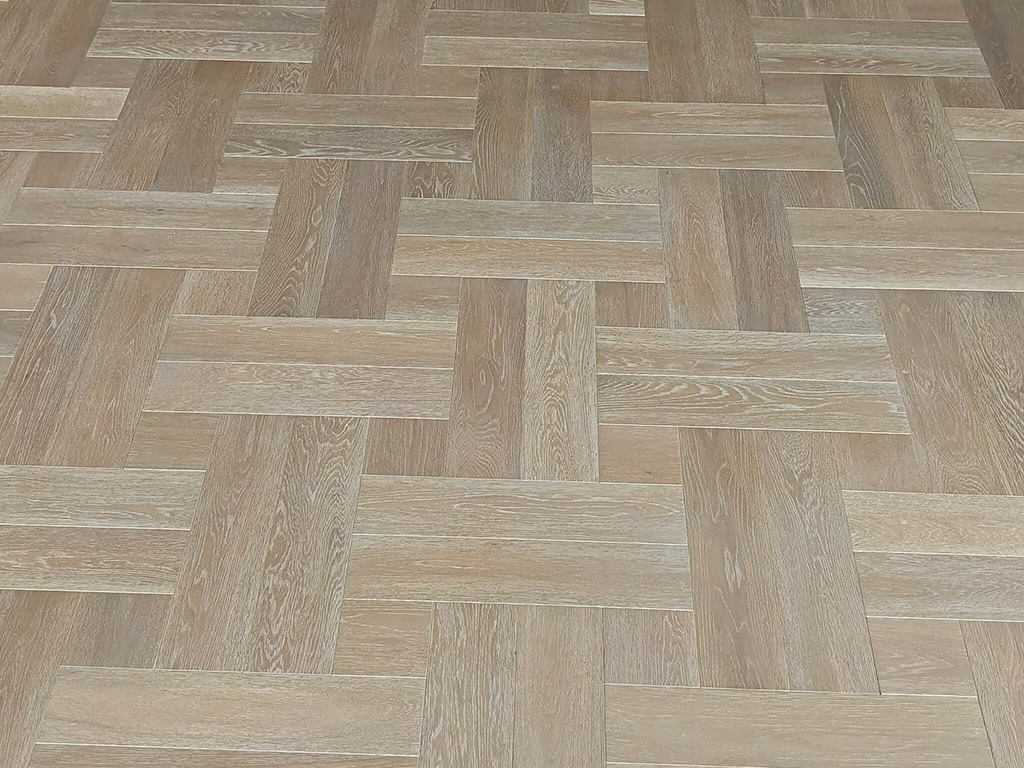
The Edge Work is Significantly More Complex
On a plank floor, edge work is straightforward: cut the plank to width and fit it against the skirting.
On a parquet floor, the edges are where the geometry of the pattern meets the geometry of the room — and those two things are almost never perfectly aligned. The cut pieces at the perimeter of a herringbone floor need to be individually measured, cut at the correct angle, and fitted so they maintain the visual logic of the pattern rather than just filling a gap. Each one is different. Each one takes time.
Around door frames, radiator pipes, hearths, and fixed obstacles, the complexity increases further. A piece of parquet meeting a curved hearth or an irregular architrave needs to be scribed or cut to fit precisely. This is the kind of detail work that separates a parquet floor that looks right from one that almost looks right — and almost isn't good enough.
The Sanding and Finishing Stage is More Technical
Once the parquet is laid and the adhesive has cured, the floor needs to be sanded — and parquet sanding is a different discipline entirely to sanding a plank floor.
The challenge is grain direction. In a straight-lay plank floor, all boards run the same way and sanding with the grain is straightforward. In a herringbone pattern, adjacent blocks run at 90 degrees to each other. In a chevron, they meet at an angle. There's no single sanding direction that works with the grain of every block simultaneously — the technique has to account for the pattern, typically using a diagonal approach across the whole floor to avoid tearing the grain of blocks where the machine runs against it.
Done correctly, a sanded parquet floor has a remarkably smooth, even surface that shows the pattern at its best. Done carelessly — wrong direction, too coarse a grit, or rushing the process — and you get visible scratches across the face of individual blocks that show clearly through any clear finish. Against a lacquered surface, cross-grain scratches on parquet are immediately obvious and very difficult to correct without sanding the whole floor again.
Parquet sanding is a craft. It's something we genuinely enjoy at Floorworks — but it's not something that can be handed to someone without the right experience and expected to turn out well.
What About Gap Filling?
One additional stage that comes up on almost every parquet project — and adds to both the time and the cost — is gap filling.
Parquet blocks move with seasonal humidity changes, and over time gaps open between them. Before the final finish is applied, we fill those gaps using a slurry made from the floor's own sanding dust mixed with a flexible resin. Because it uses dust from the actual floor, the colour match is as close as it's possible to get. It's meticulous work — particularly on a full herringbone floor where every gap between every block needs to be addressed — but it's what gives a restored parquet floor its clean, unified appearance rather than a patchwork of visible lines between individual pieces.
We always recommend gap filling for parquet restoration projects. It's not an optional extra that inflates the price for the sake of it — it's what makes the finished floor look as it should.
So, is Parquet Worth the Additional Cost?
Yes — for the right project and the right client, absolutely.
A well-laid herringbone or chevron floor is one of the most beautiful and enduring things you can put in a home. It adds genuine architectural character that no other floor type replicates. It adds value to a property in a way that straight-lay plank doesn't — buyers respond to it, surveyors recognise it, and estate agents in the London market consistently list parquet flooring among the features that justify a higher asking price.
It also lasts. A parquet floor installed and finished properly can be sanded and refinished multiple times over decades. The initial investment is higher, but the cost per year across the lifespan of the floor is often lower than alternatives that need replacing entirely every ten to fifteen years.
The additional cost of parquet installation reflects the time, skill, and precision that goes into every stage — subfloor preparation, layout planning, individual block placement, complex edge work, diagonal sanding, and careful gap filling. That work takes longer and requires more experience than a standard plank installation. The result, when it's done properly, is a floor that makes the reason clear.
Get an Expert Wood Flooring Advice from Floorworks

Parquet flooring costs more to install than standard plank for straightforward reasons: more precise materials, more demanding subfloor preparation, skilled layout planning, slower individual block placement, significantly more complex edge work, a more technical sanding process, and careful gap filling throughout. Every one of those factors adds time and expertise to the project — and that's what the additional cost reflects. At Floorworks, parquet is the work we're most passionate about, and the floors we're most proud of. If you're considering a herringbone or chevron installation in London, get in touch for a free site visit and quote.


