
When you're planning a renovation, flooring is usually the fun part — choosing wood species, deciding between herringbone and straight lay, picking the right finish. Fire ratings don't tend to come up until building control makes them an issue. But understanding where the rules apply, and why, can save you from a costly rethink halfway through a project.
Here's a straightforward guide to what UK Building Regulations (Approved Document B) actually require, and what it means for the choices you make.
When Do Fire Safety Ratings Actually Matter?
Not every floor in every home needs a fire rating — but certain situations bring it firmly into play.
Flats and apartments face the strictest rules. When people share escape routes and fire can spread between dwellings, the flooring in communal hallways, lobbies, and stairwells has to strictly limit both flame spread and smoke production. This isn't a box-ticking exercise — it's about making sure everyone in the building can get out safely.
Escape routes in houses — hallways, landings, and staircases — come under much closer scrutiny the moment you start altering the layout. Loft conversions in particular trigger detailed building control checks on these areas. Installing flooring that ignites quickly or produces heavy smoke on your only exit route is the kind of thing that fails a final inspection and requires expensive remediation.
Open-plan spaces are worth thinking about carefully too. Remove enough walls and you remove the natural barriers that slow the spread of heat and smoke. If that open zone connects directly to your front door, the flooring running through it matters more than it would in an enclosed room.
For standard rooms in a detached or semi-detached house, the rules are less prescriptive — but making considered choices is still worth doing.
The Mistake Most Homeowners Make: Judging the Floor by Its Surface
Here's something we see regularly: a homeowner sources a well-rated wood floor, fits it over a cheap foam underlay with a generic adhesive, and assumes the job is done. It isn't.
A floor's official reaction-to-fire performance is assessed as a complete installed system — every layer of it. The surface material is only part of the picture.
Underlays and adhesives are where things often go wrong. Standard foam underlays or low-quality glues can break down rapidly under intense heat, releasing dense, toxic smoke even when the timber on top is highly rated. At Floorworks, we use Tovcol MS adhesive throughout — engineered to maintain its bond and structural integrity under high temperatures, so the protection built into your flooring isn't quietly undermined by what's holding it down.
The core material behaves very differently depending on what it is. Solid wood burns slowly and predictably, forming a natural charred layer that insulates and protects the core beneath. Engineered wood and laminate behave differently — their fire performance depends heavily on the quality of the core materials, backing layers, and bonding resins used in manufacturing.
Surface finishes affect how quickly a fire can take hold. High-quality commercial lacquers seal the surface tightly, restricting oxygen from reaching the wood grain. Specialist fire-retardant primers can also be introduced during installation where stricter codes apply.
Fire Ratings Explained: What the Euroclass Scale Means for Your Floor
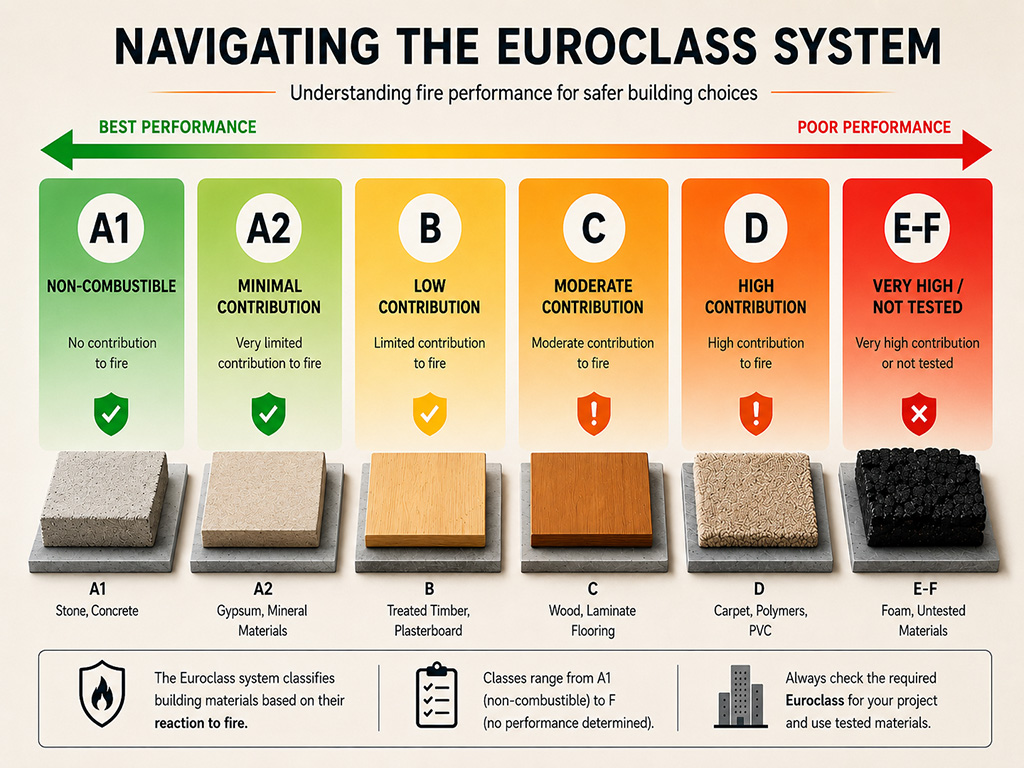
In the UK, flooring fire ratings are expressed using the Euroclass system — a scale that runs from A1 at the top to F at the bottom. Here's what each level actually means in practice:
A1 — Won't contribute to a fire at all. Think stone or ceramic tile.
A2 — Almost no contribution. Still very high performance.
B — Low contribution. The standard most regulated spaces aim for.
C — Moderate contribution. Acceptable in many domestic settings.
D — Higher contribution. Suitable only where regulations allow.
E — Ignites easily and contributes significantly. Limited appropriate applications.
F — Either untested or fails to meet the minimum threshold entirely.
Most residential flooring products land somewhere between B and E, depending on the material, how it's constructed, and what finish has been applied.
One thing worth understanding clearly: a higher Euroclass rating doesn't mean a floor won't burn. It means it burns more slowly, spreads flame less aggressively, or produces less smoke than a lower-rated alternative. The rating describes behaviour under fire conditions — not immunity to them. That distinction matters when you're trying to protect an escape route, not just pass an inspection.
Getting the Execution Right
Having the right specification on paper is one thing. Achieving it on site is another. The balance between a beautiful floor and a compliant one comes down to precise technical execution — and that requires experience, not just good intentions.
At Floorworks, our team brings extensive on-site experience to every project. From dust-free sanding to the uniform application of hard-wearing coatings like Bona Traffic HD, we assess the entire floor build-up as one unified system — subfloor, underlay, adhesive, boards, and sealant — ensuring every layer works together for both long-term durability and domestic safety.
Why the Quality of Floor Fitting Matters for Compliance
Fire performance is built into the installation, not just the product. The way underlay is laid, how adhesive is applied, how seams and edges are finished — all of these affect how a floor behaves in a fire. These are details that are easy to get wrong without proper training, and building control in flats, escape routes, and open-plan spaces will look at every layer, not just the surface.
We work only with underlay, adhesive, and sealant combinations that have been tested and verified to perform together as a complete system. We can also advise on the practical compliance issues that homeowners often miss — how floors transition between rooms with different fire rating requirements, how to maintain certification around thresholds, and how to handle the specific challenges that come with loft conversions.
This same care and system-level thinking extends to every product we install, including our newly launched Xylo Heritage LVT range. Available in three options — the Greenwich Heritage SPC click plank, the Holland Park Heritage Herringbone dryback, and the Pimlico Heritage dryback plank — the Xylo Heritage collection brings heritage-inspired design together with the waterproof durability and low-maintenance performance LVT is known for. Every product is with the same attention to system compatibility and compliance that we bring to every project.
Contact Floorworks™ for a Free Assessment and Consultation

Fire rated flooring requirements in the UK depend on where and how your property is used. Flats, shared escape routes, and open-plan layouts connected to exits face the strictest scrutiny under Approved Document B, while standard rooms in houses have more flexibility. But fire performance is never just about the surface material — underlay, adhesive, core construction, and finish all play a role, and professional floor fitting is what ties them together correctly. Speak to building control early, ask for the right documentation, and work with floor layers who treat the whole installation as one system — not a series of independent decisions.


