
A restaurant floor has to do things a domestic floor never encounters. It has to survive hundreds of people walking across it every day — people in heeled shoes, work boots, trainers, and everything in between. It has to cope with spills of wine, coffee, cooking oil, and cleaning fluid without deteriorating. It has to look good at seven in the morning when the space is being cleaned, and still look good at eleven at night when the last table is finishing. And it has to survive the cleaning regime that comes with being a food business — mopping, industrial cleaners, and the kind of thoroughness that domestic floors rarely experience.
Most floors aren't built for this. The ones that are have specific properties that make them worth understanding before any decision is made.
What a Restaurant or Café Floor Actually Has to Survive
Before getting into floor types, it's worth being clear about what the specification needs to answer — because the questions are different from residential, and the consequences of getting it wrong are felt every single trading day.
- Foot traffic volume. A busy London café might see three hundred people come through the door on a Saturday. A restaurant at full covers does the same. Every one of those visits is a pair of shoes on the floor — and over a year, that adds up to the kind of wear that would exhaust most domestic floors within months.
- Spills. This is the distinguishing factor. Water, wine, beer, coffee, cooking oil, sauce — these land on restaurant and café floors daily. The floor's surface and core have to be able to cope without staining, swelling, or degrading. For timber floors specifically, the protective finish is what stands between the spill and the wood — and that finish has to be hard enough and intact enough to do its job.
- Cleaning products. Commercial cleaning regimes use stronger products than domestic ones. A floor finish that holds up to a weekly mop in a home may degrade under daily industrial cleaning. This is why the choice of sealant matters as much as the choice of floor in a commercial context — and why we specify different products for restaurant and café floors than we would for a residential project.
- Noise. A hard floor in a busy hospitality space generates noise — footsteps, chairs scraping, dropped cutlery. This is increasingly a factor in hospitality design, particularly in café formats where background noise is a customer experience issue. Acoustic underlays and floor specification choices can influence this.
- Appearance over time. A floor that looks great on opening day but starts showing wear within six months is a problem — not just aesthetically, but because restoration in a trading business requires closing or working around the space in ways that aren't always convenient.
The Floor Types: What Works and What Doesn't
Hardwood Timber — The Statement Choice
Solid and engineered hardwood flooring is the most visually impactful choice for a restaurant or café, and it's the one most commonly associated with premium hospitality interiors. A well-laid herringbone oak floor in a Soho restaurant tells you something about the establishment before you've looked at the menu. That visual impact is real, and it has a commercial value.
It's also a demanding specification in a hospitality context — and getting the details right is what determines whether a timber floor in a restaurant performs or becomes a constant maintenance problem.
The key variables are the finish and how it's maintained.
For restaurant and café timber floors, we always specify the most durable commercial lacquer available — Bona Traffic HD as the standard, with Tover Maxima 2K for the highest-demand environments. These are two-component water-based polyurethanes that cure to an exceptionally hard film — far harder than single-component products — and resist the combination of foot traffic and commercial cleaning that restaurant floors face. The number of coats matters too. We apply a minimum of three coats of lacquer on commercial timber floors — primer plus three topcoats — because the additional film build is what extends the service life of the finish between restorations.
What timber floors in restaurants need that domestic floors don't is a clear maintenance protocol for the team on the ground. The right cleaning products — pH-neutral, free of wax and soap — used consistently make the difference between a finish that lasts three years and one that needs attention in eighteen months. We discuss this at handover on every commercial project.
For restaurant and pub floor sanding and restoration, our approach addresses the specific challenge of hospitality environments — thoroughly removing residues of any spillages during the sanding process before sealing with the most durable commercial finish available. This is something we're specific about, because a floor that's been sealed over accumulated grease or liquid residue won't hold its finish properly.
Parquet Flooring — Character With Commercial Credentials
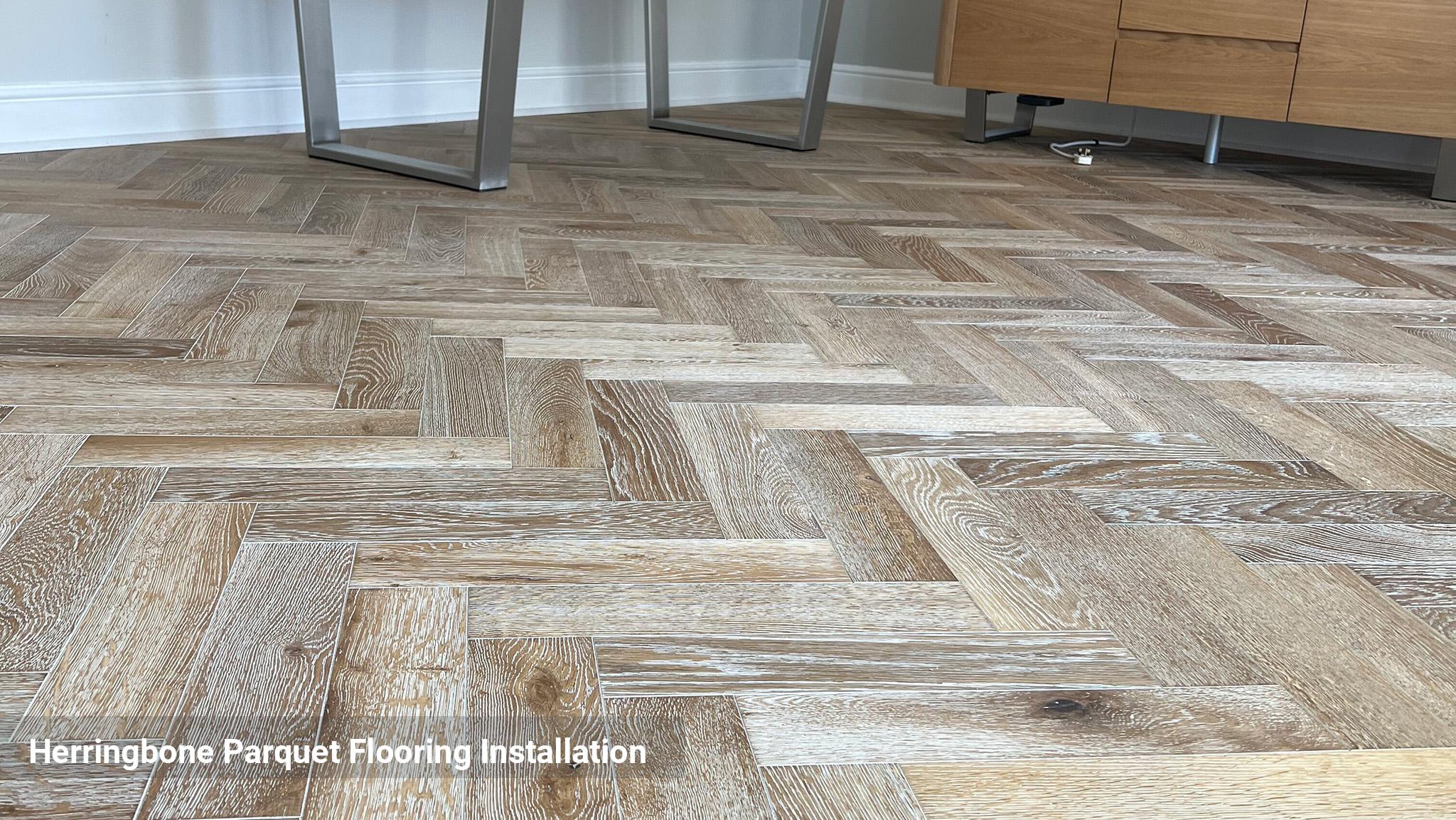
Parquet — herringbone and chevron patterns in particular — has become one of the defining features of contemporary hospitality interiors in London. From neighbourhood cafés to hotel restaurants, the geometric pattern signals quality and intention in a way that straight-lay plank doesn't quite match.
From a performance perspective, parquet in a restaurant context works well when it's correctly specified and maintained. The individual blocks are short, which means the floor distributes wear more evenly than long planks — there's no single weak point at the end of a board the way there can be with plank flooring. The adhesive bond in a glue-down parquet installation also makes it more stable underfoot than a floating floor, which matters in a hospitality environment where floor stability contributes to safety.
The same finishing principles apply as for plank timber — commercial-grade 2K lacquer in multiple coats, with the right maintenance products used consistently. The sanding and restoration of parquet in a restaurant context requires removing all trace of contamination — cooking oils and liquids penetrate into parquet joints and have to be fully removed by the sanding process before any sealant is applied. See our parquet floor restoration service for more on how we approach this in commercial environments.
Engineered Wood — The Practical Timber Option
Engineered hardwood gives you the real timber aesthetic with greater dimensional stability than solid wood — less movement in response to humidity fluctuation, better compatibility with underfloor heating, and a specification that works across a wider range of subfloor conditions. In a restaurant or café context, these properties are practically useful: kitchen areas produce humidity, heating systems run continuously in cold months, and subfloor conditions in older commercial buildings are often less than ideal.
The surface layer is real hardwood and takes the same commercial lacquer finishes as solid timber — meaning the appearance and the protection level are equivalent to solid wood on the surface, with improved structural performance beneath it. For restaurant and café installations where the subfloor condition or the humidity environment is a factor, engineered wood is often the more reliable specification than solid.
For engineered floor installation in commercial premises, the subfloor preparation is, as always, the foundation of everything — levelling, moisture testing, and the right adhesive system all have to be right before the first board goes down. We use Tovcol MS adhesive throughout our commercial glue-down installations — a product that maintains its bond through the temperature and humidity fluctuations that commercial kitchens and dining spaces produce.
LVT and SPC — The Waterproof Alternative
Luxury Vinyl Tile and SPC flooring have become increasingly common in hospitality environments — particularly in café formats, fast-casual restaurants, and spaces where the volume and nature of spills makes a genuinely waterproof floor the practical requirement.
The case for LVT and SPC in a restaurant or café is straightforward: it's waterproof at the core, it's resilient under sustained foot traffic, it doesn't require the maintenance regime that timber demands, and it comes in formats — including herringbone patterns — that produce a genuinely good-looking floor rather than an obviously practical one. For a café with a high-turnover operation and a cleaning-intensive daily routine, these properties have real commercial value.
The consideration is longevity and character over time. LVT and SPC don't develop the patina that timber does — they look the same on the day they're installed as they do five years later, which is both an advantage (consistency) and a limitation (no character development). In a premium restaurant where the floor is part of the atmosphere, timber is usually the right answer. In a high-volume café where operational practicality is the priority, LVT is often more appropriate.
Our LVT floor fitting service covers both click and glue-down formats — glue-down being the preferred specification for commercial environments where the absolute stability of a bonded floor matters under sustained traffic.
Laminate — Where to Be Careful
Laminate flooring has a place in some commercial environments, but restaurants and cafés are not generally where it belongs. The core swells irreversibly when it absorbs moisture, and in a hospitality environment where spills happen multiple times daily, the risk of water penetrating the joints and reaching the core is significant. A laminate floor that's been saturated by a spill can't be restored — it needs replacing.
If laminate is already in a restaurant or café space that's being refurbished, the honest recommendation in most cases is to replace it with a more appropriate floor type rather than to maintain it. We can install laminate flooring where it's the right specification — but in a food and drink environment, it rarely is.
Contact Floorworks™ for Professional Flooring Solutions

Timing the Work Around the Business
One of the most practical challenges of commercial floor work is the disruption to trading. A restaurant or café that's closed is losing revenue — which means the work has to be completed quickly, efficiently, and without extending into trading hours any longer than necessary.
At Floorworks, our approach to restaurant and café flooring services is built around this reality. We work outside trading hours wherever possible — evenings, early mornings, and weekends. For larger projects, we phase the work so that part of the space remains operational while another section is being treated. And we use water-based lacquer systems specifically because they dry fast enough to return a floor to use the next day — which matters enormously when every closed hour has a commercial cost.
The dust-free sanding equipment we use throughout every project is not just about cleanliness — in a food business, it's an operational requirement. A restaurant that can't open because of residual sanding dust isn't something any client wants to deal with.
Maintenance: What Keeps a Restaurant Floor Looking Good Between Restorations
The best floor in the world deteriorates faster than it should if the daily maintenance isn't right. For hospitality environments, this is especially important because the intensity of use means that small maintenance failures accumulate quickly.
- Use the right cleaning products. pH-neutral cleaners specifically formulated for sealed timber or vinyl floors are what preserve the finish. Soaps and wax-based products leave residue that dulls the surface over time and can cause the finish to degrade prematurely. Many commercial cleaning companies use generic products that aren't appropriate for specialist floor finishes — it's worth specifying to your cleaning team exactly what should and shouldn't be used.
- Deal with spills immediately. The protective finish is what stands between a spill and the floor beneath it — but prolonged contact with liquids, particularly acidic ones like wine and coffee, will eventually work through even a commercial-grade finish if left long enough. A spill blotted up immediately causes no damage. The same spill left overnight on a timber floor is a different conversation.
- Schedule maintenance recoats. A professional screen-and-recoat — lightly abrading the existing finish and applying a fresh topcoat — every two to three years in a busy restaurant is far less disruptive and far less expensive than waiting until the finish has worn through completely and a full sand and refinish is needed. It also means the floor never looks tired.
Summary
The right floor for a restaurant or café depends on the trading environment, the aesthetic ambition of the space, and the maintenance commitment the business can realistically sustain. Hardwood timber — solid or engineered — finished with commercial-grade 2K lacquer is the premium specification that delivers the best combination of appearance and longevity in most hospitality environments. Parquet adds architectural character and distributes wear well. LVT and SPC are the practical choice where waterproof performance is the priority. Laminate is rarely the right answer in a food and drink context.
What all of these have in common in a restaurant or café setting is that the installation and the finish have to be done to a higher standard than a residential equivalent — because the floor takes more, and the consequences of getting it wrong are felt every trading day.
At Floorworks, our commercial flooring service for restaurants and pubs is built around those higher demands — working around trading schedules, using dust-free equipment, specifying the most durable finishes available, and providing the ongoing maintenance support that keeps a floor performing between restorations.
Get in touch for a free site visit and quote — we'll assess the space, discuss the options, and give you a clear recommendation for a floor that works as hard as your business does.


