
Parquet flooring has a character that few materials can match — the warmth of individual timber blocks, the elegance of a herringbone or chevron pattern, the sense that whoever laid it cared about doing something that would last. And for the most part, it does last. A well-made parquet floor from the 1940s or 1950s can still be a genuinely beautiful floor today, given the right attention.
But life happens. Decades of foot traffic, the occasional leak, years under carpet, a previous owner who thought a coat of paint was a reasonable solution — all of these things take their toll. And at some point, you're standing in a room looking at a floor that clearly needs something, trying to work out what that something is.
This is where most people get stuck. Not because the answer is complicated, but because nobody has explained what the symptoms actually mean. Here's how to read them.
The Symptoms: What Is Your Floor Actually Telling You?
Before anyone talks about restoration or replacement, the floor needs to be properly read. The symptoms visible on the surface are diagnostic — they tell you what's happened to the floor and what it's capable of withstanding. Here's what to look for.
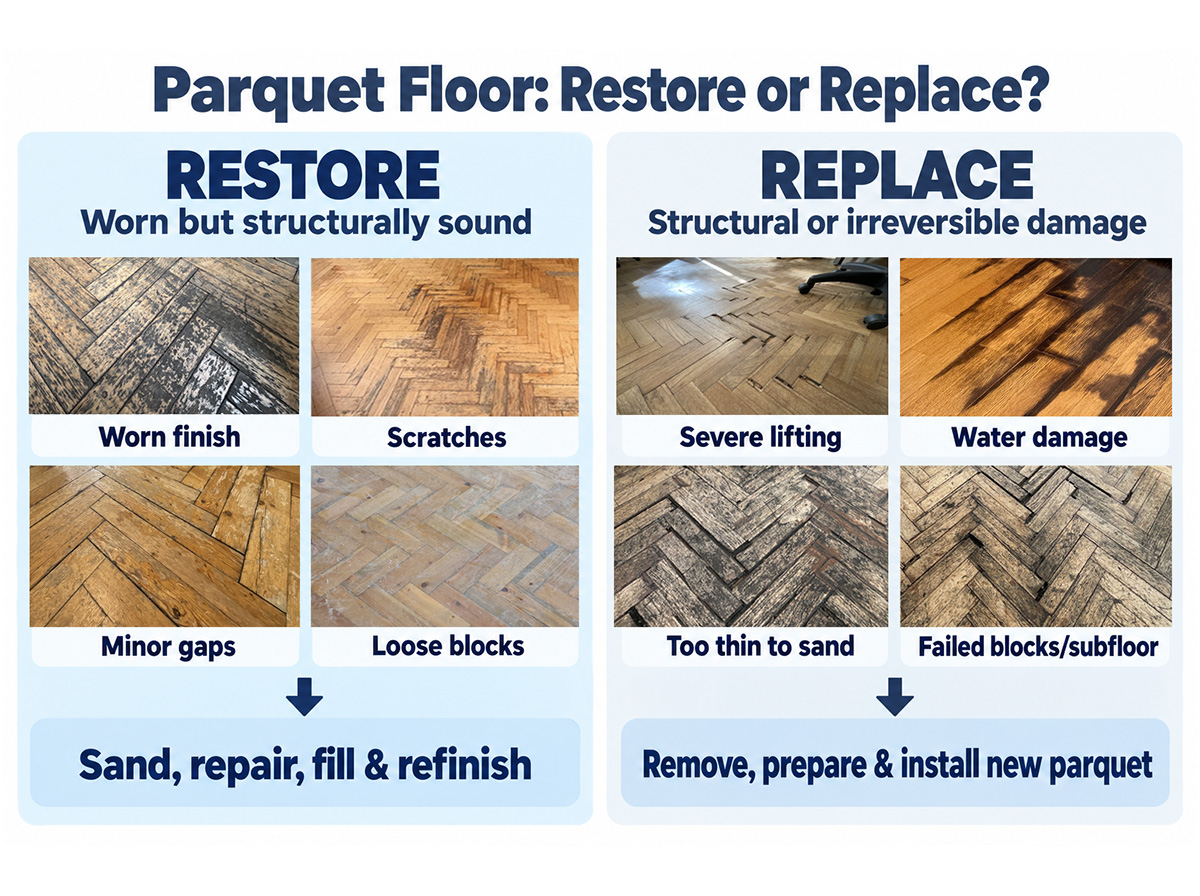
Symptoms That Point Toward Restoration
-
A dull, flat, or patchy finish
The protective layer has worn through in places — usually in the highest-traffic zones like doorways and in front of sofas. The timber beneath is still sound. This is one of the clearest indicators that a professional sand and refinish is all that's needed.
-
Surface scratches and scuff marks
Scratches that haven't penetrated deep into the timber are a surface problem, not a structural one. Sanding removes the damaged layer and exposes fresh wood underneath. This is exactly what the restoration process is designed for.
-
Blocks that sound hollow underfoot
Walk slowly across the floor, listening. Blocks that have lost their adhesive bond will produce a hollow knock when pressed. This is very common in older parquet — the adhesive ages, dries out, and the bond fails. It sounds worse than it is. Re-bonding loose blocks is a standard part of parquet floor restoration and doesn't affect the restorability of the floor overall.
-
Minor gaps between blocks
Small gaps that have opened between blocks through seasonal movement are normal and addressable. Gap filling using a flexible resin mixed with the floor's own sanding dust closes them invisibly and is a standard part of the restoration process.
-
Discolouration and uneven colour
Floors that have sat under rugs for decades develop patches where some areas are darker or lighter than others. Old stains, faded finish, UV exposure over years — all of this is resolved through sanding, which brings the whole floor back to a uniform raw timber surface before a new finish is applied. Wood floor staining can unify colour even further if needed.
-
When Should I Restore or Replace My Parquet Flooring
If the floor has had contact with water but the cupping of the blocks is within 2mm and the floor has fully dried, restoration is almost always viable. The surface damage from the water — staining, minor distortion — can be addressed through sanding once the moisture content has returned to normal.
Contact Floorworks™ Today for a Free Professional Consultation

Symptoms That Point Toward Replacement
-
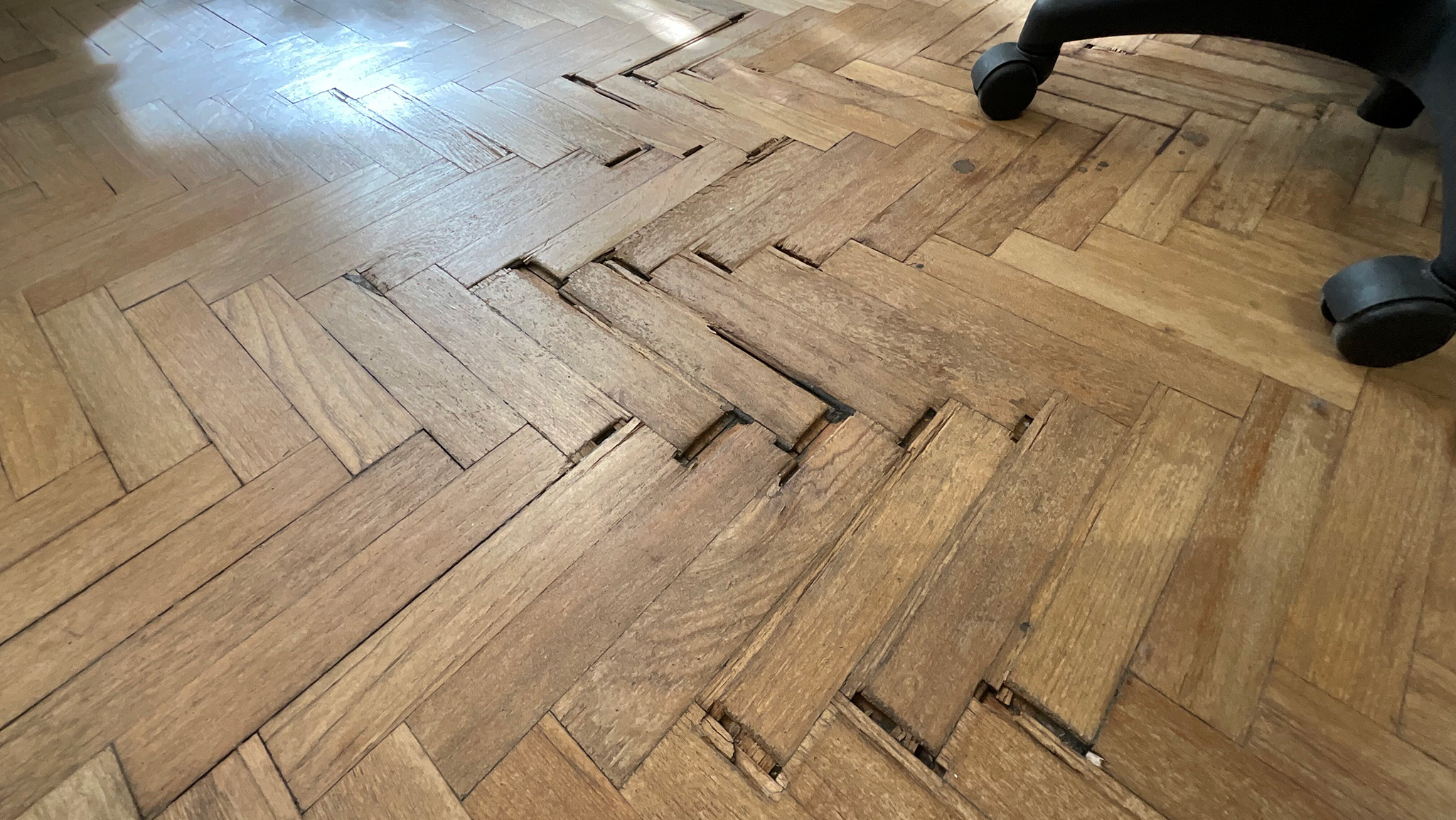
Deep structural cupping or buckling
Blocks that have cupped severely — bowed upward at the edges with the centre dropped — and haven't returned to flat after drying have permanently changed shape. Sanding can correct minor cupping, but beyond a certain point the block can't be brought back to flat without removing so much material that there's nothing left to work with.
-
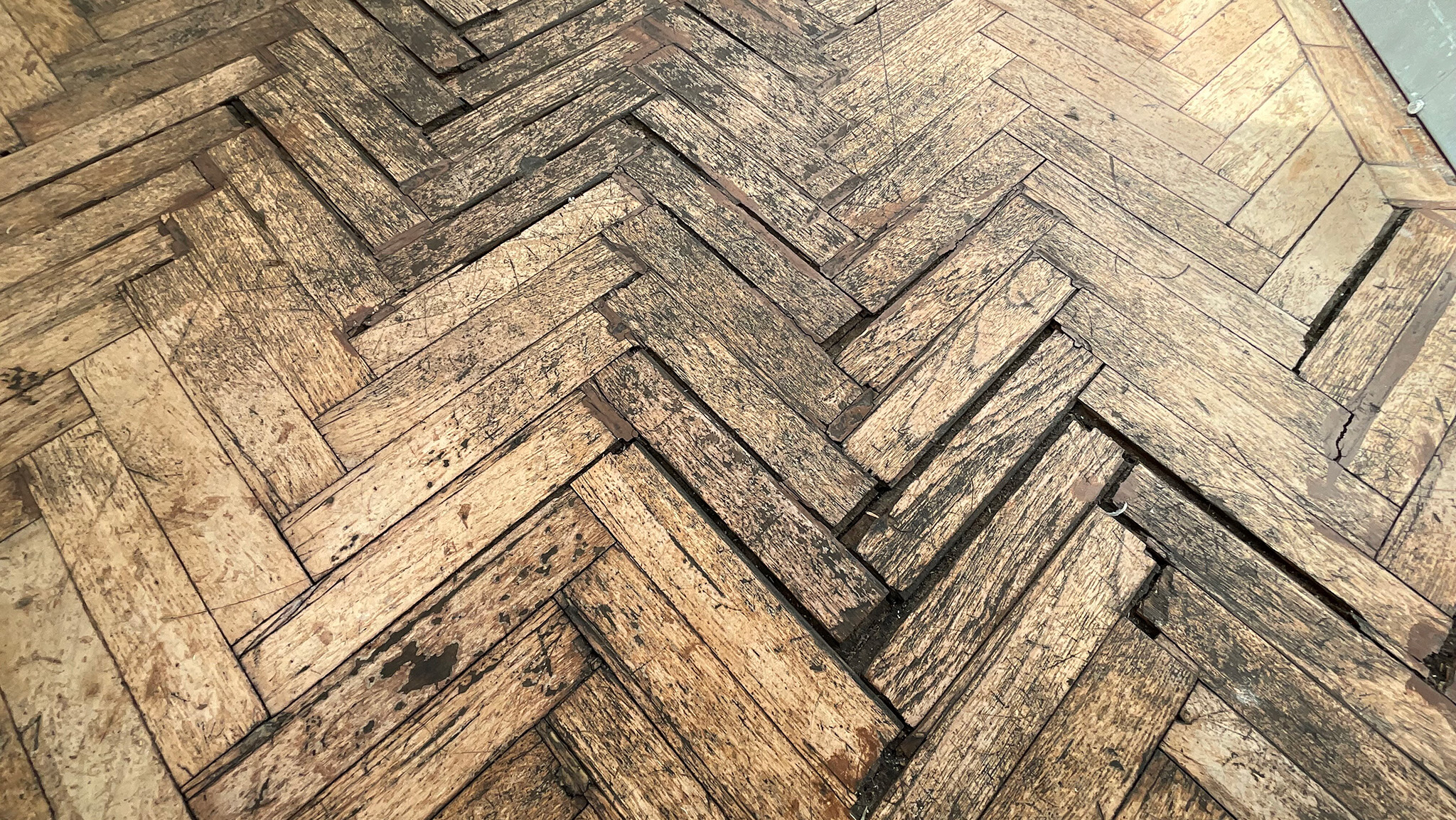
Rot, woodworm, or deep water damage
Active woodworm, softened or crumbling timber, blocks that are structurally compromised by long-term moisture exposure — these aren't surface problems. If the timber itself has lost its structural integrity, restoration isn't a viable option and replacement is the honest recommendation.
-
The floor has been sanded too many times
Every sanding cycle removes a thin layer of timber. Parquet blocks have a finite amount of material above the tongue-and-groove joint, and once that's been used up, there's nothing left to sand safely. If the floor has been restored multiple times over the decades and the blocks are visibly thin, a further sanding cycle risks breaking through to the joint entirely. This needs to be checked on site before any work is agreed.
-
Significant numbers of missing or damaged blocks
A block here and there is replaceable — we source reclaimed parquet blocks to match existing floors in size, species, and colour, and replace individual pieces as part of restoration. But a floor where large sections are missing, broken, or fundamentally different from the rest raises a question about whether matching the existing floor is realistic or whether starting fresh makes more sense.
-
A major water leak that's been left too long
If a leak went unnoticed for days, or if the floor was wet for an extended period without proper drying, the damage can be beyond what restoration can address. Subfloor damage, deep structural change in the blocks, or mould beneath the surface all potentially push the decision toward replacement. If your floor has been affected by a significant water event, read our full guide on what to do when your wooden floor is affected by a leak before making any decisions.
-
You're significantly changing the layout of the space
This is a practical consideration rather than a condition issue. If walls are coming down, rooms are being extended, or the footprint of the space is changing significantly, matching existing parquet across the new area is genuinely difficult. The block size, species, and patina of reclaimed timber can be matched closely, but it's rarely invisible. A uniform new installation across the whole reconfigured space is almost always the cleaner result.
When Restoration Is the Right Answer — and What It Involves
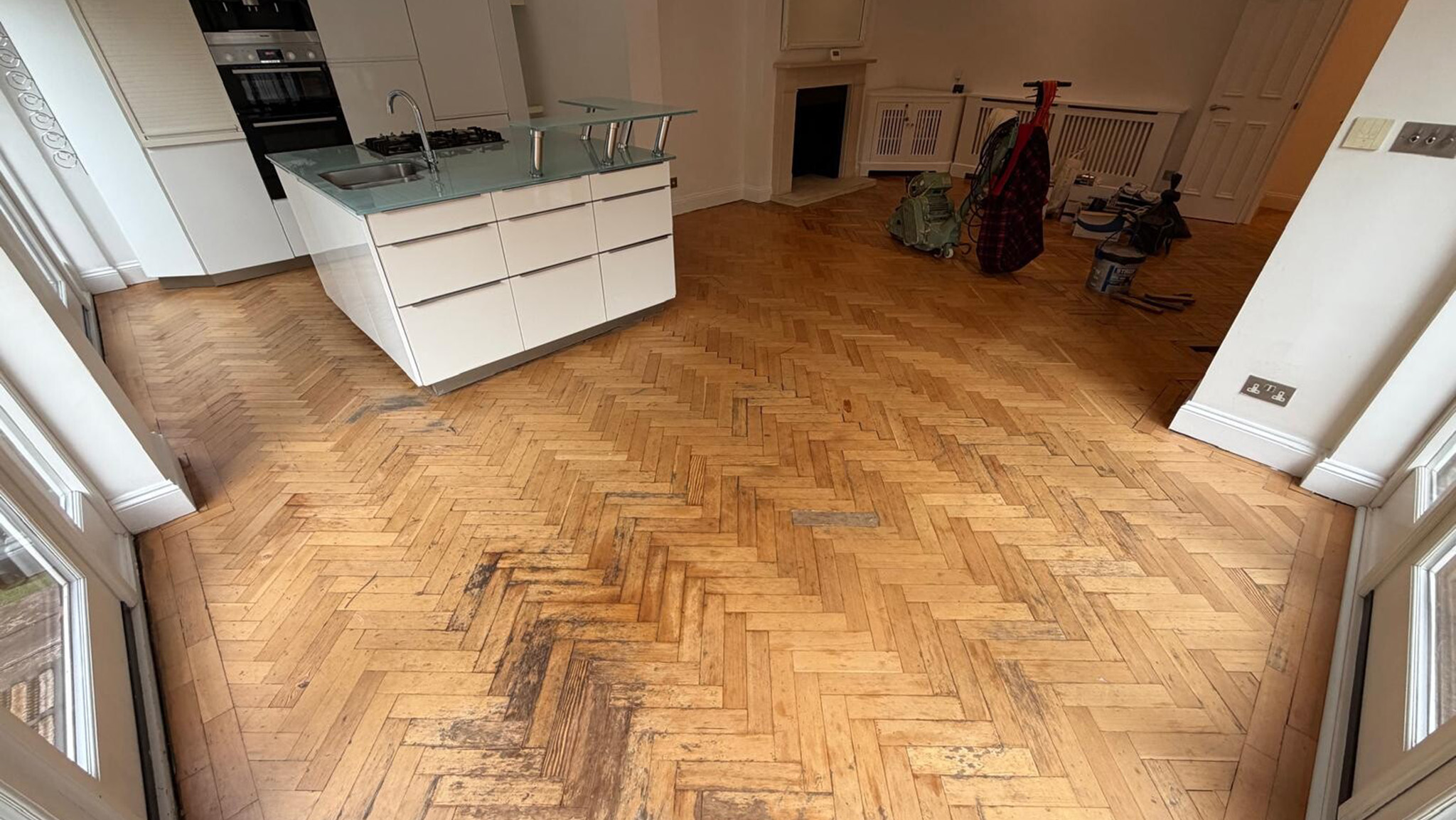
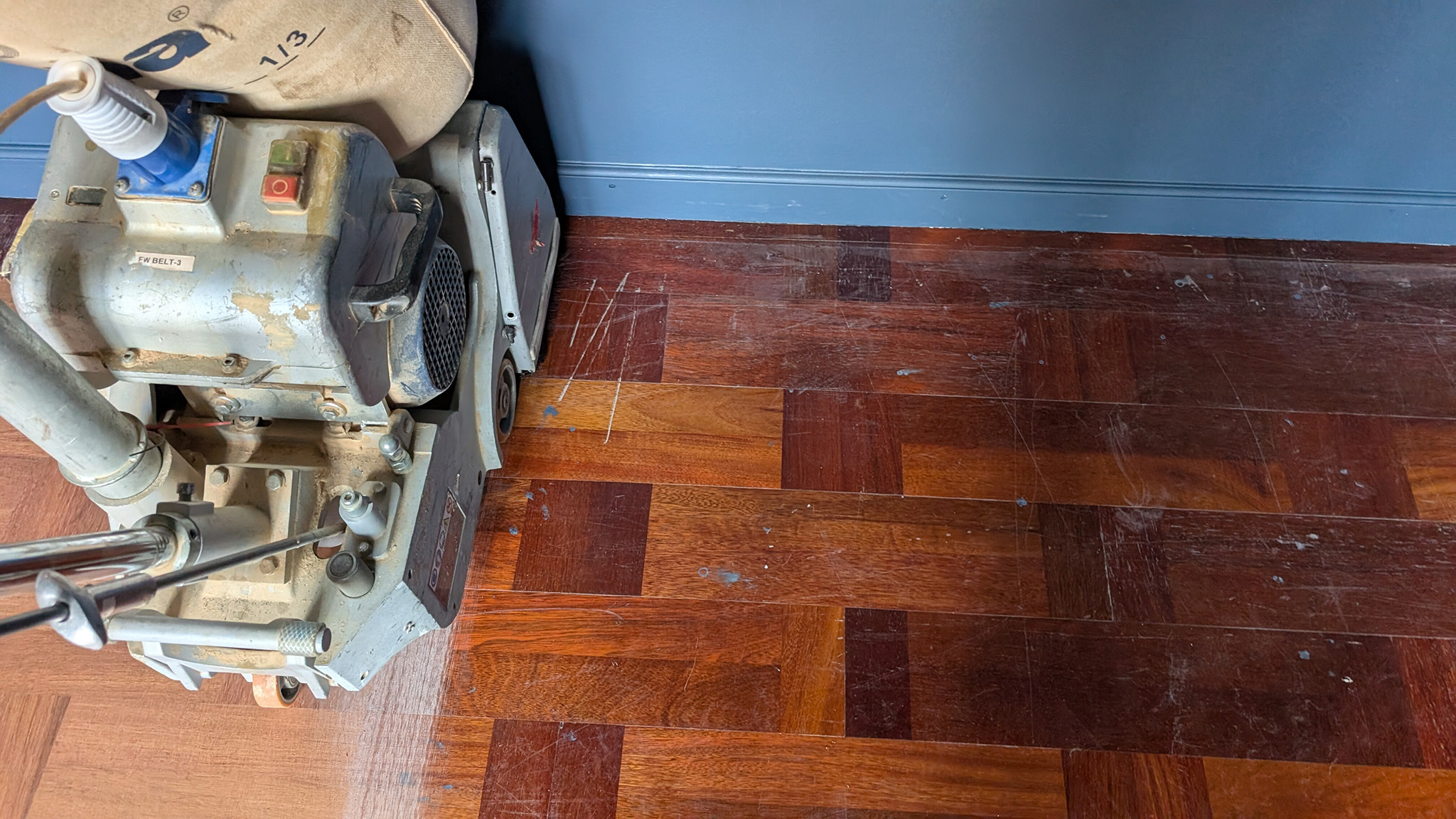
Restoration is the right path for most parquet floors in reasonable structural condition. It costs significantly less than replacement, it preserves timber that often can't be replicated, and it delivers a result that looks genuinely new while keeping the character and history of the original floor.
Here's what the process actually looks like.
Assessment and repairs first. Before any sanding begins, the floor is assessed properly. Loose blocks are identified and re-bonded — we use Tovcol MS adhesive throughout, a professional-grade product that maintains its bond through seasonal timber movement. Missing or unsalvageable blocks are replaced with reclaimed pieces matched as closely as possible in size, species, and colour. Any structural issues at subfloor level are addressed. None of this work is optional — sanding a floor that still has structural problems just buries them under a fresh finish.
Professional parquet floor sanding. Once the floor is stable and all repairs are complete, the sanding begins. Parquet sanding is technically more demanding than sanding a straight-lay plank floor because adjacent blocks run at 90 degrees to each other — the sanding direction has to account for the grain of every block in the pattern simultaneously. We work diagonally across the herringbone using progressively finer grits, stripping back the old finish and surface damage until the whole floor is back to clean, bare timber. For a step-by-step breakdown of the full sanding sequence — starting grits, direction changes, edge sanding, and the between-coat buffing stage that determines the quality of the final finish — see our parquet floor restoration guide.
The finishing decision. This is where the floor's character for the next decade gets defined. For high-traffic areas, hallways, and open-plan spaces, we typically recommend Bona Traffic HD — a two-component water-based lacquer that provides exceptional durability and can take light foot traffic within 12 hours of the final coat. For clients who want a more natural appearance with a softer sheen, Osmo Polyx Hardwax-Oil penetrates the timber rather than coating it and is easier to spot-repair if the floor gets damaged in a specific area. We'll talk through both at the site visit and make a recommendation based on the floor and how the space is actually used.
The result is a floor that looks close to new — with the character and warmth that only comes from timber that's been there for fifty or a hundred years.
When New Installation Is the Right Answer — and What It Involves
When restoration genuinely isn't viable, or when the project calls for something different from what's already there, new parquet installation is the right path. This isn't a consolation prize — a well-specified and well-installed new parquet floor is a significant upgrade to a property.
Subfloor preparation is the foundation of everything. A new parquet installation lives or dies by what happens before a single block goes down. The subfloor must be level to a tight tolerance — no more than 3mm variation across a two-metre straightedge — and completely dry and structurally sound. Parquet laid on a poorly prepared subfloor will develop buckling and gaps within months, regardless of how good the material is. For detail on what subfloor levelling actually involves — including the 3mm maximum per coat rule for acrylic levelling compound, the curing time required before blocks go down, and how bitumen removal affects the concrete beneath — see our parquet floor restoration guide. This stage is where the quality of the installation is really determined, and it's where inexperienced contractors cut corners that show up later.
Layout planning before laying. A herringbone or chevron pattern doesn't start from a wall and work across the room — it starts from a carefully calculated centre point that accounts for the room's geometry and ensures the pattern reads correctly from the main viewpoint. Getting this wrong produces a floor where the geometry looks slightly off without the viewer being able to immediately explain why. It takes time to do properly, and it's one of the things that separates a parquet floor that looks right from one that almost looks right.
The species and specification decision. New installation gives you design freedom that restoration can't — the choice of species, pattern, block size, finish, and whether to go solid or engineered. European oak is the most popular choice for its colour, grain, and hardwood credentials. American walnut gives a richer, darker result. Engineered parquet — a real hardwood surface layer bonded to a stable core — is the right specification when underfloor heating is part of the project, since solid vintage parquet and underfloor heating are a difficult combination.
The Three Questions Worth Asking Before You Decide
If you're still not sure which path is right after reading the symptoms above, these three questions will usually settle it.
-
What does the floor actually look like below the surface?
This is the question only a site visit can properly answer. Tapping blocks, checking the timber thickness, assessing the adhesive condition, taking moisture readings — these are things that need to be done in person. We offer free site visits across London and will give you an honest assessment of what's there and what's realistic.
-
Has the floor been affected by water?
Water damage changes the picture significantly. A floor that's been wet needs to be assessed differently from one that's simply old and worn. If your floor has been affected by a leak — whether recently or in the past — read our guide on what to do when a wooden floor is affected by a leak for a detailed breakdown of how different types and degrees of water damage affect your options. The short version: if the damage was caught quickly and the floor has fully dried, restoration is almost always viable. If it sat wet for an extended period, the options narrow.
-
Are you changing the space?
If the answer is yes — walls coming down, an extension being added, an open-plan layout being created — then matching existing parquet across the new footprint is a real practical challenge. It's worth having that conversation at the site visit before committing to a restoration approach that may produce a visible join between old and new.
FAQ
-
How do I know if my parquet floor can be sanded again?
The key factor is the remaining timber thickness above the tongue-and-groove joint. This needs to be checked on site — we use a gauge to measure at thresholds and around radiator pipes where the floor profile is accessible. If there's insufficient material left, we'll tell you before any work is agreed.
-
Can water-damaged parquet be restored?
In many cases, yes — provided the floor has fully dried, the cupping of the blocks is within manageable limits, and the subfloor hasn't been compromised. The full answer depends on the extent of the damage and how quickly the floor was dried after the event. See our guide on wooden floors affected by leaks for a detailed breakdown.
-
Can you match reclaimed blocks for a partial replacement?
Yes, in most cases. We work with reclamation yards and timber suppliers to source blocks that match in size, species, and colour. Where an exact match isn't possible, wood floor staining applied after sanding can unify the colour across old and new timber so the repairs are effectively invisible.
-
How long does parquet floor restoration take?
For a typical room of around 40 square metres, the full process — assessment, repairs, sanding, and finishing — takes between two and four days. Larger projects, or floors requiring significant repair work before sanding, take longer. We'll give you a realistic timeline at the site visit.
-
What's the difference between lacquer and oil for parquet?
Lacquer sits on top of the timber as a hard film — more durable, easier to clean, better for high-traffic spaces. Oil penetrates the wood and produces a more natural appearance, with the advantage that worn areas can be spot-repaired without refinishing the whole floor. We recommend Bona Traffic HD for lacquered parquet and Osmo Polyx Hardwax-Oil for oiled finishes — and we'll discuss both options at the survey based on your floor and how the space is used.
Get a Free Expert Flooring Advice from Floorworks
A parquet floor that looks tired, scratched, or damaged isn't automatically a floor that needs replacing. In most cases — particularly for solid oak or pine parquet in reasonable structural condition — professional restoration is the smarter, more cost-effective, and more sustainable choice. The symptoms that point toward restoration are surface-level: worn finish, scratches, hollow blocks, minor gaps, uneven colour. The symptoms that point toward replacement go deeper: structural cupping that hasn't recovered, timber that's been sanded to its limit, severe water damage that's compromised the blocks or subfloor.
If you're not sure which category your floor falls into, the right next step is a site visit — not a decision made from photographs. We offer free, no-obligation assessments across London and will give you an honest picture of what's possible before any commitment is made. If you'd like to understand the full restoration process before your site visit — the sanding sequence, the gap filling stage, the finish options, and what to expect at each step — our parquet floor restoration guide covers the complete process from loose block removal through to the final coat.


