
If you've ever lived beneath someone with a wooden floor, you'll know exactly what we're talking about. Every footstep. Every chair being pulled back. Every dropped item. Timber floors are beautiful, durable, and endlessly restorable — but they don't absorb sound the way carpet does, and in a flat or a home with multiple floors, that difference is felt by everyone in the building, not just the person who chose the floor.
The good news is that acoustic insulation for wooden floors has come a long way. The right product, installed correctly under the right floor type, makes a genuine and measurable difference. The less straightforward news is that "acoustic underlay" covers a wide range of products with very different properties, performance levels, and compatibility requirements — and choosing the wrong one for your floor type or your specific noise problem doesn't just underperform, it can cause installation problems that cost more to fix than the underlay saved.
Here's what you actually need to know — and which products we recommend for which situations.
Understanding Impact & Airborne noise
Before choosing any acoustic product, it's worth being clear about which type of noise you're dealing with — because they're solved in different ways.
Impact noise is the sound of physical contact with the floor — footsteps, dropped items, furniture being moved, children running. It travels through the structure of the building itself, which is why it's heard so clearly in the flat below. Reducing impact noise requires a resilient layer between the floor surface and the structure beneath it — something that absorbs the energy of the impact before it transfers into the building fabric.
Airborne noise is sound that travels through the air — voices, music, television. For this, mass is the solution — adding density to the floor build-up makes it harder for sound waves to travel through. Acoustic underlays alone rarely solve airborne noise significantly; a more comprehensive approach involving the floor build-up as a whole is usually needed.
Most acoustic underlay products address impact noise primarily. If airborne sound transmission is your main concern — particularly in converted flats or properties with thin concrete floors — the solution needs to go beyond the underlay layer alone.
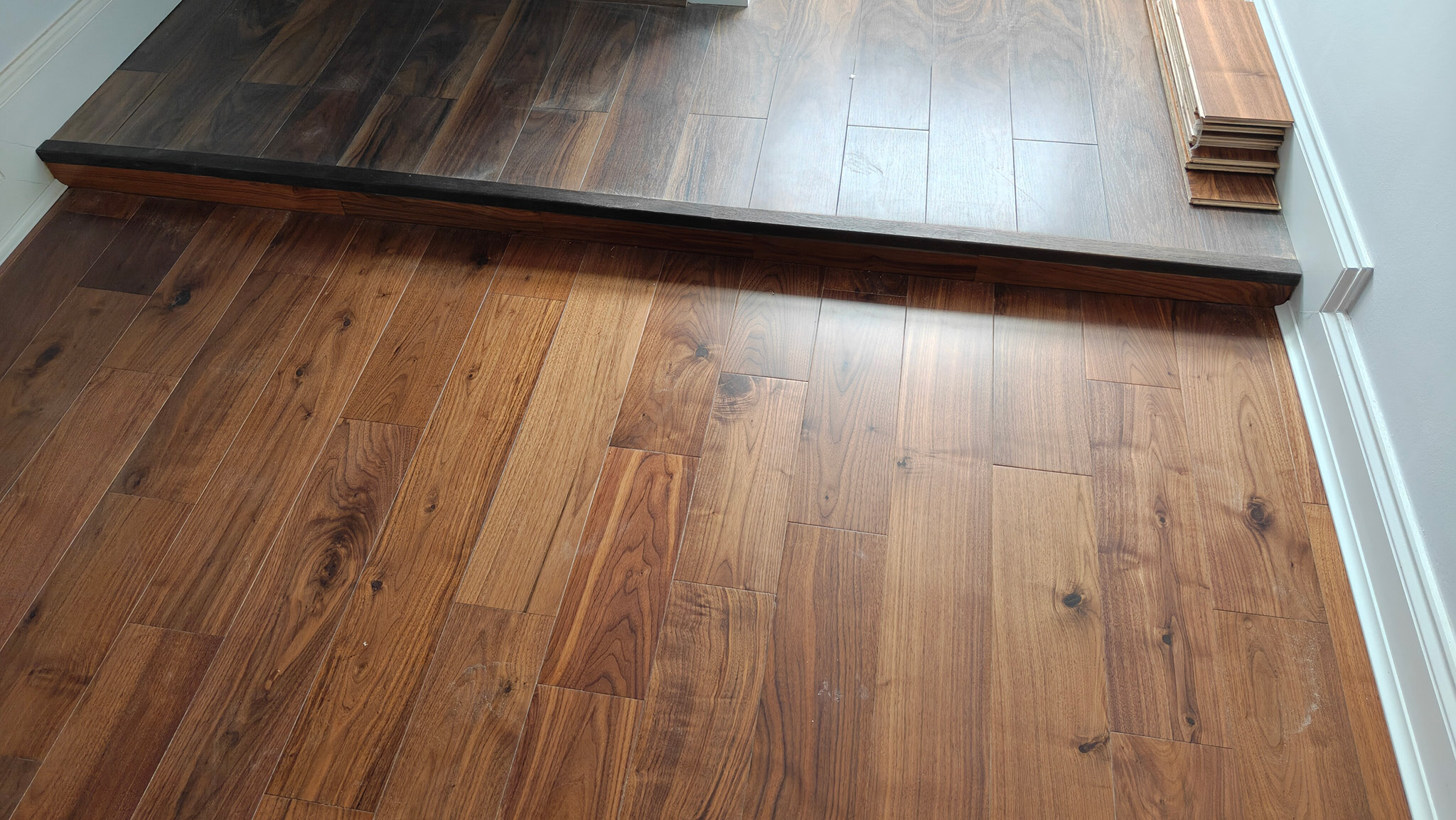
How Acoustic Underlay Works With Different Floor Types
This is the detail that determines everything, and it's where a lot of homeowners get caught out.
Floating floors — engineered timber, laminate, and click LVT installed without adhesive over an underlay — can use a full range of acoustic underlay products. The underlay sits between the floor and the subfloor, decouples the floor from the structure, and absorbs impact energy before it transfers downward. The thickness and density of the underlay directly affects performance — denser, thicker products perform better acoustically.
Glue-down floors — parquet, dryback LVT, and solid wood fixed directly to the subfloor with adhesive — cannot use standard floating underlays. The floor is bonded directly, so the underlay has to be a product compatible with glue-down installation: typically a rubber mat that is itself adhered to the subfloor, with the floor then glued on top. This is a specifically engineered build-up and uses different products from floating installation underlays.
Solid wood floors with the exception of Junckers — which uses a unique clip system that allows specific underlays beneath the boards — are generally not compatible with underlay in the conventional sense. Their acoustic performance depends on the subfloor build-up and the joist cavity beneath it rather than a product layer beneath the boards.
Understanding which category your floor falls into is the first step before choosing any acoustic product.
The Products We Offer: What Each One Does
Floorworks™ DPM Backed Wood & Laminate Underlay, 3mm
This is our own Floorworks-branded underlay — a 3mm product with an integrated DPM (damp-proof membrane) backing, designed specifically for engineered wood and laminate floating installations over concrete subfloors.
The DPM backing does two jobs at once: it provides basic acoustic performance to reduce impact noise transmission, and it protects the floor above from moisture rising through the concrete subfloor. For ground floor rooms and basement conversions where both concerns are present simultaneously, combining both functions in a single product keeps the build-up clean and the floor profile as low as possible at doorways and transitions.
It's the right starting point for straightforward installations where the acoustic requirement is moderate and moisture protection is a practical necessity. If a higher level of acoustic performance is needed, one of the Duralay products below will be the more appropriate specification.
Timbertech2 Silver Plus Underlay, 3mm
Timbertech2 Silver Plus is a step up in acoustic performance from the basic DPM product — a 3mm rubber-based underlay that combines sound reduction with moisture barrier protection, suited to floating engineered wood and laminate installations.
The rubber construction is what gives it better acoustic performance than foam-based alternatives. Foam underlays compress over time and lose their resilience — a foam underlay that's been under a floor for a few years has often lost a significant proportion of its original thickness, which means the acoustic performance has degraded. Rubber holds its density far better, which is why we favour rubber-based products for installations where long-term performance matters as much as day-one results.
Timbertech2 Silver Plus is a reliable, well-rounded product that suits most standard residential floating floor installations where acoustic and moisture performance are both part of the brief.
Duralay Excel Silver
Duralay Excel Silver is a high-performance rubber underlay with an integrated moisture barrier — one of the most widely specified acoustic underlays for engineered wood and laminate floating installations in the UK residential market, and one we recommend regularly.
The rubber core provides genuine impact sound reduction that holds up over time, and the moisture barrier makes it appropriate for use over concrete subfloors without the need for a separate DPM layer. It strikes a strong balance between performance and practicality — enough acoustic improvement to make a meaningful difference in a flat or a first-floor room, without the added cost of the premium products.
For most residential engineered wood floating installations where acoustic performance matters, Excel Silver is the default specification we start from.
Duralay Timbermate Excel Silver Flooring Underlay
Timbermate Excel Silver is Duralay's version of the Excel Silver formula specifically designed for timber and engineered wood floors — same core rubber construction and moisture barrier, refined for the specific requirements of wood flooring rather than laminate.
The distinction matters because engineered wood and laminate have different compression tolerances. A product that performs well under laminate doesn't necessarily behave identically under a thicker, denser engineered board. Timbermate Excel Silver is engineered to support the specific load and movement characteristics of timber flooring, which makes it the more precise specification when engineered wood is the floor type.
It's the product we specify for engineered wood floating installations where the client wants reliable acoustic performance without moving to the premium tier.
Duralay SilentFloor Gold
If acoustic performance is the absolute priority, SilentFloor Gold is the specification. It's Duralay's premium acoustic underlay — higher density rubber, engineered specifically for superior impact sound reduction — and it's what we recommend when minimising footstep noise transmitted to the floor below is the primary concern.
The difference between SilentFloor Gold and the Excel Silver products is measurable. In a flat, a converted property, or any situation where the floor is directly above a habitable space and noise transmission is a genuine problem, the additional cost of the Gold specification is easily justified by the performance difference.
It works with engineered wood and laminate floating installations and provides the best impact noise reduction available within a standard underlay layer. For situations where building regulations impose specific acoustic performance requirements on a party floor, this is where the conversation starts.
Duralay Timbermate SilentFloor Gold, 4.20mm
Timbermate SilentFloor Gold is the timber-specific version of the SilentFloor Gold formula — the same premium acoustic performance, refined for engineered wood flooring rather than laminate. At 4.20mm, it's thicker than the standard products, which contributes to both its acoustic performance and its underfoot comfort.
For engineered wood floating installations where acoustic performance is the priority — first floor rooms above habitable spaces, flat conversions, any situation where the floor regulation or the neighbour situation demands the best available solution — Timbermate SilentFloor Gold is the product we specify.
The extra millimetre of thickness compared to 3mm products is worth checking at door thresholds before specifying, particularly where the height differential between the new floor and an adjacent floor type is already tight.
Between the Joists: Mineral Wool for Timber Subfloors
For timber subfloor situations — original floorboards, a suspended floor with a joist cavity beneath it — the acoustic approach is different from anything that sits under the finished floor surface. The joist cavity itself is where the acoustic treatment needs to go.
Mineral wool — Rockwool (stone wool) or acoustic-grade fibreglass — installed between the joists is the most effective material for this application. It absorbs sound within the cavity, reducing the transmission of both impact and airborne noise through the floor structure.
The key distinction here is density. Standard thermal-grade mineral wool is effective for heat retention but not optimised for sound. Acoustic-grade mineral wool — higher density, specifically manufactured for sound absorption — performs significantly better in acoustic applications and is what we recommend for joist cavity treatment where noise reduction is the goal.
The practical consideration is access. Installing mineral wool between joists is straightforward when the floor is coming up as part of a renovation — it can be laid into the cavity before the subfloor goes back down. Retrofitting it in a floor that isn't being disturbed is more complex and depends on whether access is available from below.
For more detail on joist insulation options, see our floor insulation and soundproofing guide.
Mass Loaded Vinyl (MLV): The Specialist Option
Mass Loaded Vinyl is a dense, flexible sheet material that adds mass to a floor build-up to reduce airborne sound transmission. It's not an impact noise product — it's specifically for situations where the transmission of sound through the air (voices, music, television) between floors is the problem.
MLV is added as a layer within the floor build-up — typically beneath the subfloor or between the subfloor and the finished floor — and its density interrupts the path of airborne sound waves more effectively than lightweight products. It's heavier, denser, and more expensive than standard acoustic underlays, which is why it's reserved for situations where airborne sound is a documented problem rather than a general acoustic upgrade.
In flat conversions and multi-occupancy buildings where airborne sound transmission is a compliance requirement, MLV is often part of a more comprehensive acoustic specification alongside joist treatment and impact underlays.
Choosing the Right Product: A Simple Guide
The right acoustic product depends on three things: your floor type, your installation method, and which type of noise you're trying to address.
Floating engineered wood or laminate over concrete, standard acoustic requirement: Floorworks™ DPM Backed Underlay 3mm — moisture protection and basic acoustic performance combined in one layer, keeping the floor profile low and the build-up simple.
Floating laminate or engineered wood, reliable mid-range acoustic performance: Duralay Excel Silver — high-performance rubber with an integrated moisture barrier, the product we specify most often for residential floating floors where acoustic performance genuinely matters.
Floating engineered wood specifically, reliable mid-range acoustic performance: Duralay Timbermate Excel Silver — the same Excel Silver formula refined for the load and movement characteristics of timber flooring rather than laminate. The more precise specification when engineered wood is the floor type.
Floating laminate or engineered wood, premium acoustic performance: Duralay SilentFloor Gold — the highest-density rubber in our range, engineered specifically for superior impact sound reduction. This is where the conversation starts when building regulations impose acoustic requirements on a party floor, or when the neighbour situation means footstep noise really cannot be ignored.
Floating engineered wood, premium acoustic performance: Duralay Timbermate SilentFloor Gold 4.20mm — the timber-specific version of SilentFloor Gold. Thicker, denser, and the product we specify for engineered wood floating installations where acoustic performance is the priority. Worth checking the door threshold height before specifying if the floor profile is already tight.
A step up from the DPM product, not yet at Duralay level: Timbertech2 Silver Plus 3mm — a rubber-based underlay with moisture barrier that sits between the Floorworks DPM product and the Duralay range in terms of performance. The right choice for standard residential installations where a rubber construction is preferred over the basic DPM but the full Duralay specification isn't needed.
Timber subfloor with accessible joist cavity: Acoustic-grade mineral wool between the joists — not a product that sits under the floor surface, but a treatment of the structure itself. More effective for both impact and airborne noise than any underlay product alone, and the right approach when the floor is coming up as part of a renovation and the cavity is accessible.
Glue-down parquet or solid wood: Speak to us at the site visit — glue-down installations use rubber mat products adhered to the subfloor rather than floating underlays, and the right specification depends on the acoustic target and the subfloor conditions.
If you're not sure which applies to your situation, a site visit resolves it quickly. The subfloor type, the floor being installed, and the specific acoustic concern all come into focus when someone is actually in the space — and we'll give you a clear recommendation rather than a list of options to choose from yourself.
Summary
Acoustic insulation for wooden floors isn't one product or one solution — it's a set of options matched to specific floor types, installation methods, and noise problems. Rubber products like Regupol and db FFR handle glue-down installations. Duralay, Timbertech, and Novostrat products address floating floor situations across a range of performance levels. Mineral wool between joists treats the structure itself. Mass Loaded Vinyl targets airborne sound specifically. The right specification starts with understanding which type of noise is the problem and which installation method the floor requires — and then matching the product to both.
At Floorworks, acoustic insulation is part of every floor installation project where the floor type and situation calls for it. We advise on the right product at the site visit stage — before anything is ordered — so the specification is right for the specific floor, subfloor, and acoustic requirement rather than a generic recommendation. See our full underlay and insulation page for more detail on the products we stock and install, or get in touch to discuss your specific project.


